Art in memory of Oscar


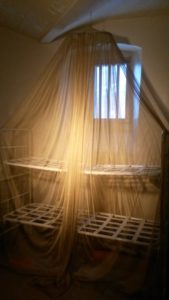
20161030_110147A visit to the memorable Artangel installation at Reading Gaol, that most Victorian of prisons with its red-brick cruciform shape and wire-grilled segregation.  I filmed ‘Oscar‘ for the BBC here when it was still an active prison some 20 years ago; it closed in 2013 and is now scheduled to be sold off.  But before it is, Artangel have continued their bold and imaginative curating of art spaces that no one normally reaches by getting artists and writers like Ai Weiwei and Anne Carson to leave messages in the cells that reflect Oscar Wilde’s incarceration here.  The finest of these offerings by far comes from Steve McQueen – a sculpture in which a prison bed is swathed in mosquito nets like a cocoon of the imagination.

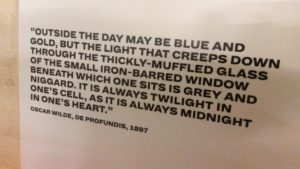
20161030_111831I revisit Oscar’s cell – C.2.2.  When I filmed here, it was being used by two inmates so was even more crowded than in Wilde’s day – although he had to endure a harsh regime of physical labour.  ‘The most terrible thing about it is not that prison breaks one’s heart – hearts are made to be broken – but that it turns one’s heart to stone,’ as he wrote in De Profundis, his book-length letter from the cell.

20161030_111753
Wilde’s cell with a rose left as offering

On the day I visit, Patti Smith gives a three hour reading from De Profundis in the prison chapel.  She sings a short burst from two songs at the opening and close – first from Nina Simone’s  ‘Wild is the Wind’, then from her own ‘Wind’.  There are sections of the letter where, as Patti admits (‘What did that last bit mean?  I have no idea…’) Wilde can lose the reader as he goes off on wild and lonely tangents.  But there are also passages of haunting beauty: ‘I threw the pearl of my soul into a cup of wine.’  It is a fitting tribute and one Patti delivers with passion and empathy.

20161030_113729
Steve McQueen’s ‘Weight’, with gold-plated mosquito netting

.

Oscar, the film I made with Michael Bracewell for the BBC, is still available on iPlayer

20161030_113619

Art in memory of Oscar Read More »

The 21 Best Films of the 21st Century

cinma


The BAFTA season is about to begin, and as I have done for some twenty years, I will be sitting down to watch the best films of the year before voting.

Before I do, this is a personal response to a recent list where worldwide critics did their poll of polls for the best 100 films of the millennium for the BBC.

These professional film critics have in the usual way opted for obscurity over clarity – quite ridiculous for Mulholland Drive, The Tree of Life and Eternal Sunshine of the Spotless Mind to be in the top 10 when a straw poll of regular punters would show no one had a clue what any of them were on about. Or cared.

My own Top 21 favours innovation and pure cinema over cult credibility and if that means some blockbusters and animated films, so much the better. And I think I’m right in saying that only a very few of them won the Oscar or BAFTA for Best Film (answers on a postcard).  The majority don’t even make the 100 chosen by worldwide critics.  But they are the films of the century so far that I still think about and return to in my mind – that still live with me.

The 21 Best Films of the 21st Century Read More »

Surfing in Peru

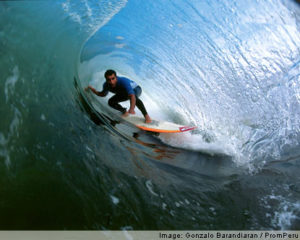
‘Here’s the thing,’ the surfer tells me as he changes into his wetsuit. We look offshore at the monstrous wave of Pico Alto as it comes charging towards us. ‘That wave gets to 40ft high. But it’s not just the height. It’s the depth of water behind it. It’s triangular. So if that thing comes down on you, it feels like a brick house coming down – with you underneath it.’

.

He runs towards the water before I learn his name.

I have been coming to Peru for 35 years and it still excites – perhaps because of its endless capacity to surprise. Although I know the Inca heartland around Machu Picchu best, I have come to love the long Pacific coastline, with its pyramids and fabulous beaches.

Today I am 25 miles south of Lima in the town of Punta Hermosa, where the new mania for surfing in Peru has precipitated a building boom. Rows of brand-new white apartment blocks gleam in the sun on the cliffs above a whole series of incredible waves: Caballeros (Gentlemen), a right-hander, is matched chivalrously by Señoritas (Ladies), an equally impressive left-hander. Further out is the daunting sight of Pico Alto – meaning high summit.

see the rest of my article as first published in British Airways High Life magazine

Surfing in Peru Read More »

Embrace of the Serpent

20160621_170716[1]

.

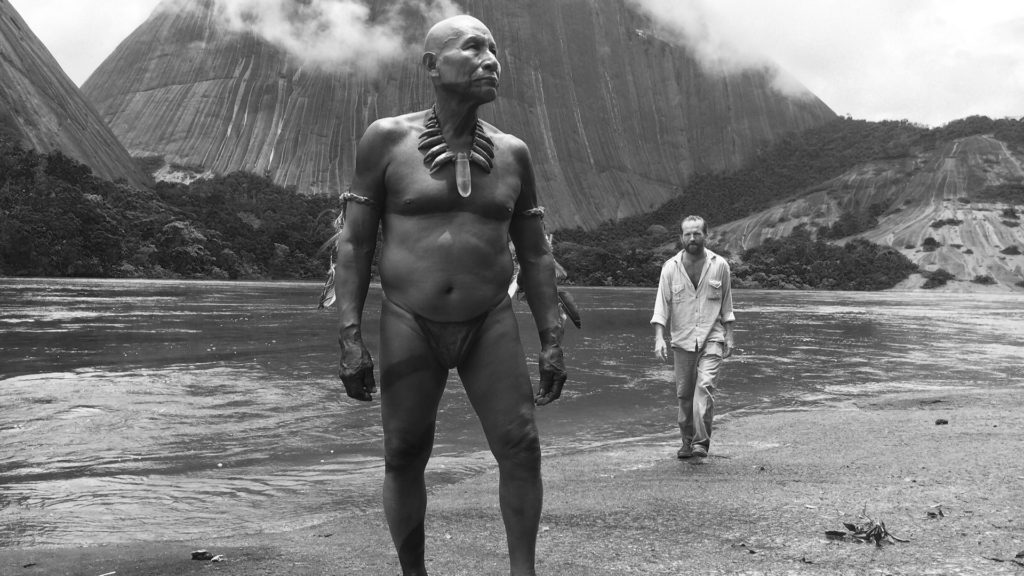
Nominated for an Oscar and already much feted, Embrace of the Serpent can now be seen in British cinemas and is a revelation.

The masterstroke is filming the Amazon in black and white – counter-intuitive but brilliant – and letting the strange dreamlike journey play out along the river.

I am less certain that the dual narrative – many decades separate the two different storylines – works quite so well, and at times the anthropology can creak at the seams, but at its best, this is an odyssey along the most serpentine of all rivers, with many way-stations and dangers for the travellers in their canoes.

The Colombian director, Ciro Guerra, is not afraid to allow strange epiphanies to creep in:  a comet passes overhead at one point, lighting up the dark faces of those below; the torches of mission children are like fireflies in the night. The photography throughout is both numinous and luminous, shot on Super 35.

There’s been some discussion about the historical background to the film.  The producers say that ‘the film was inspired by the real-life journals of two explorers (Theodor Koch-Grünberg and Richard Evans Schultes)’, but anthropologist have already been quick to note the discrepancies:  Koch-Grünberg, for instance, had no interest in hallucinogenics.  The historian John Hemming has pointed out to me that the brilliant and disturbing depiction of the messianic shaman with his own cult is based on Venancio Christo, active in that region from the late 1850s to early 1860s – half a century before Koch-Grünberg and a century before Schultes.

But as an imaginative interpretation of the spirit of the Amazon, this film must surely be hard to beat. And while Fitzcarraldo had previously set the benchmark, that was a film about the European psyche; this tries to be one about the mindset of the South American Indian.

embrace1

Embrace of the Serpent Read More »

Jim Curran – A Tribute

51t2dQ+OjHL._SX324_BO1,204,203,200_I was very sorry to hear that Jim Curran had died.  He was an ebullient and kind figure who was generous with his help – and whisky – to writers like me who were less familiar with the mountaineering world.  When I wrote my book about Nanda Devi, he gave invaluable advice.
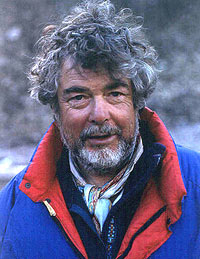
I was also drawn to him because he was a talented filmmaker as well as writer. The underappreciated late film he made with Chris Bonington when they attempted a remote peak in Tibet – and Bonington has to face up to the ageing process – is a classic and I shared Jim’s frustration that it was screened so badly by television that few ever saw it.  Overall he shot some 15 documentaries featuring alpine giants like Joe Tasker, Peter Boardman and Alan Rouse. 

He championed the cause of mountaineering films with his stewardship of the annual Kendal Mountain Film Festival and one of my proudest memories is being awarded one of their bronze statuettes of prayer flags.

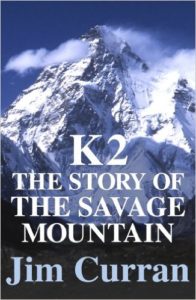
Both Bonington and K2 have been lucky to have such an accomplished and sympathetic biographer.  In the summer of 1986, 13 climbers died on K2, climbing tragedies that aggressively carved the epithet the “savage mountain” into the public consciousness. Jim Curran was at the mountain all summer. The following year, Curran’s scrawled notes became K2 – Triumph and Tragedy. He went on to write his most famous book, K2 – The Story of The Savage Mountain, which won him the 1996 award for best non-fiction at the Banff Mountain Book Festival: ‘a tribute to all those who have set foot on K2, both living and dead.’  He was a five-time nominee for the Boardman Tasker Prize for Mountain Literature.

jimportBut aside from his multiple creative achievements, one quality will always stand out for me about Jim – a quality that is not always a given in the focused, over-achieving world of mountaineering: he was extraordinarily generous and terrific company.

Jim Curran – A Tribute Read More »

the ‘lost’ Swedish artist Hilma af Klint

20160405_163959[1]Regular readers know that this blog occasionally touches on great art exhibitions I chance across, but rarely, as frankly there aren’t that many of them about.

But the new exhibition at the Serpentine of the ‘lost’ Swedish artist Hilma af Klint (1862–1944) is definitely worth celebrating.

Although a pioneer of early abstract art – predating Klee, Kandinsky and many others – she was only rediscovered in the 1980s, as she worked well out of the mainstream. Fearing that she would not be understood, she stipulated that her abstract work should be kept hidden for 20 years after her death. After a few exhibitions around the world, she is now being hailed – rightly – as a maverick and visionary.  Both qualities I value.

Not unlike Yeats and some of the Surrealists, she wove together spiritualist sources that we might now find dubious, from Mme Blavatsky to her mentor, anthroposophist Rudolf Steiner, to create art of luminous integrity.

Her abstract paintings, perhaps because she was making up the rules as she went – and she was not part of the 20th century mainstream – feel very different; perhaps her nearest equivalent would be, much later, Sonia Delaunay.

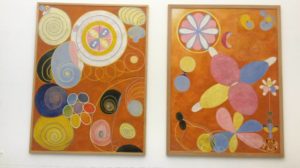
The Paintings for the Temple sequence – which af Klint thought she had been ‘commissioned’ to paint by a celestial entity named Amaliel – are at their most magnificent in the eight large paintings celebrating the passage of life which fill the central gallery at the Serpentine.

20160405_162118The looping circles of colour are matched by her similarly looping handwriting, as if giant pages from a molecular notebook on life – and she worked for a while as a draughtswoman at the veterinary institute in Stockholm in 1900.

To stand in this gallery was one of the most intense artistic experiences I’ve had for some time.

the ‘lost’ Swedish artist Hilma af Klint Read More »

María Rostworowski obituary

maria.

With her absorbing yet accessible accounts of the Peruvian world before the arrival of the conquistadors, María Rostworowski, who has died aged 100, brought the Incas to life for countless readers. Perhaps more than any intellectual in Peru, she reconfigured our understanding of the ancient Andean mind.

.

Her 1953 biography of the Inca emperor Pachacútec paved the way for the more extensive and groundbreaking Historia del Tahuantinsuyu (1988, translated in 1999 as History of the Inca Realm), which deconstructed the suppositions made by some Spanish colonial historians – including the very European idea that the Incas had an empire at all in the Roman, imperial sense. She argued it should be seen more as a trade confederation.

She also showed how Andean principles of kinship wove a complicated thread through Inca politics, which did not observe European principles of primogeniture but instead depended more on a matrilineal line of influence; nobody had written much previously about the mothers of Inca emperors.

María looked for documents that had never been studied before: the bureaucratic records of the courts, censuses and tax registers. Some of the most interesting material she found was in lawsuits brought by claimants just after the conquest. She uncovered a wealth of material, and about a dozen books and countless articles built up a picture of the pre-Columbian world in which the central element of reciprocity was stressed.

see my full obituary in The Guardian

María Rostworowski obituary Read More »

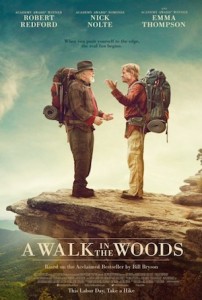
A Walk In The Woods

A_Walk_in_the_Woods_Poster.

A Walk In The Woods is a curious film and proposition.

Bill Bryson wrote his book in the 1990s, when he himself was in his 40s like his friend Katz, with whom he makes this journey along the Appalachian Way.

Robert Redford wanted to turn this into a movie – but with himself playing Bryson, despite the fact that Redford is in his late 70s and looks absolutely nothing like the bearded writer.

Despite the incongruity, critics have been a little unkind to it, as it’s worth watching for the gentle humour with which things unfold – and gentle humour is a rare commodity in movies these days.  Also, the film – and the Bill Bryson character – are lucky enough to have Emma Thompson as a (much younger) wife, who always brings some welcome asperity and wit to proceedings.

Nothing is less filmic than a man walking or hiking slowly across landscape – which is why movie-makers since the time of John Ford always try to get them on a horse, wagon or fast moving car.  When I was making travel documentaries myself, I always used to dread the bits when my presenter would ponderously stumble along with a backpack.

But the filmmakers make a decent fist of it here and if it is all a tad inconsequential – particularly the jeopardy moment when they fall off a very small ‘cliff’ and think themselves stranded – there’s a slow, loping charm which is very much like the act of walking across such a landscape.

A Walk In The Woods Read More »

Sound and Light at the Peabody where East meets West

20160205_155639Excited to be in Salem for a remarkably innovative weekend put together by Sona Datta and her colleagues at the Peabody Essex Museum.

As some readers may remember, I made a series for the BBC with Sona last year – Treasures Of The Indus – for which we travelled to Pakistan and India.

Now Sona is not only having a screening of the films for an American audience, but has tied it into a new exhibition by the talented Anila Quayyum Agha, who has created an installation that conjures up the spirit of Spain’s Alhambra Palace, where a thousand years ago Islamic and Christian traditions thrived in coexistence.

A square black cube of steel weighing some 600 lbs has been laser cut by Anila into filigree work like that of a jali screen, so that the light from a single bulb inside creates a shimmering effect around the yellow room.  (I did ask her how she was ever going to change the bulb…)

And Sona is also putting on a Night at the Museum party, hosted by my old friend Bee Taylor and his House Of Honey collective, when more light projections will be played around the atrium of the building itself.

The fact that outside it’s blowing a Boston snowstorm won’t stop some determined partying.

Sound and Light at the Peabody where East meets West Read More »

Unravelling the quipu

quipu 2.

Of all the ancient civilisations, we know least about Peru because, as an illiterate society, they had no writing. They did, however, leave quipus, elaborate knotted cords mentioned by the Spanish chroniclers, which have still not been fully deciphered.  These remain one of the most tantalising challenges in archaeology.

.

There are around 600 known quipus around the world, either in museums or private collections.  Some of these quipus follow a straightforward numerical pattern, as if itemising goods.  Others are more random and difficult to interpret.  And even with the numerical quipu, we have no way of knowing what the numbers refer to, as for the vast majority there is no provenance – the quipus have arrived in collections from dealers, from the booty of conquistadors, from looted tombs, or by accident.

Until now.  The team led by Harvard’s Gary Urton has been looking at some quipu discovered recently near the goods they may have itemised – a potential breakthrough, if not, as he is careful to say, a Rosetta Stone.  The quipus – or khipus  – were buried under the remnants of centuries-old produce, which was preserved thanks to the extremely dry desert conditions.

We long for the pre-Columbian civilisations to be able to speak to us direct from beyond the grave:  is there some Homeric tale, some Peruvian Gilgamesh, of which we know nothing? Yet there is a danger that our overwhelming desire for the quipu to be proved a form of language could force us into unnatural contortions to prove that what may still just be an accounting device is actually much more.

see Cochineal Red for a more detailed discussion of quipus and other aspects of pre-Columbian civilisation (published as A Sacred Landscape in USA)

Unravelling the quipu Read More »

Scroll to Top