
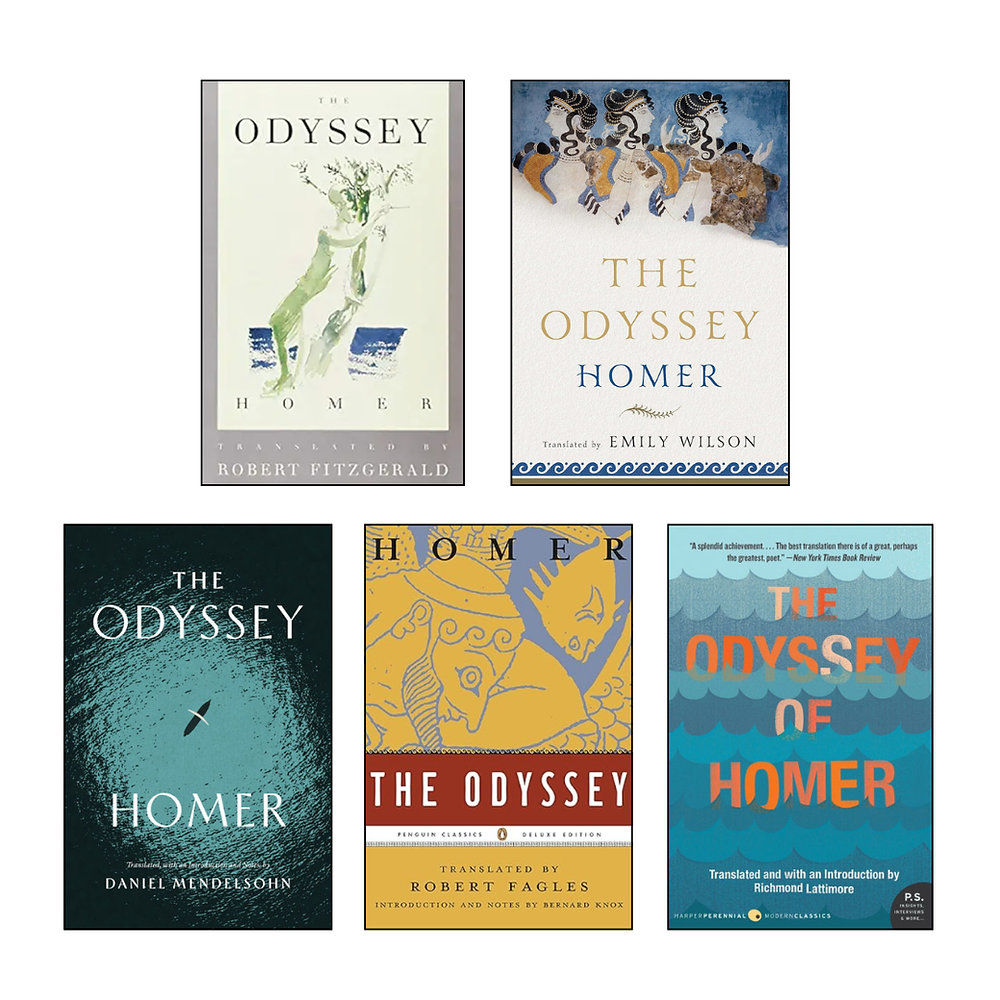
 A warning against making too fashionable a decision when choosing a translation of ‘The Odyssey’.
So you’ve bounded out of Christopher Nolan’s Odyssey high on aristeia, prowess in war, and philotimia, the love of honour. And now you want ‘to read the book’, which you’ve always meant to do and never quite got around to. You’ve heard that Nolan himself recommended Emily Wilson’s recent translation; and the buzz is all about that on TikTok. The Guardian loves her. She’s the first woman ever to have translated Homer into English, so it’s got to be good, right? (the ‘into English’ qualification is needed because women have done it into other languages). Your finger is reaching for the Kindle button or maybe you’re sticking to old fashioned print and you’re heading to a bookshop.
Stop, in the name of Homer!
Emily Wilson has taken the thick treacly mead of Homer and strained it through a cloth of puritanism into a tight bottle to be sealed away. There is no poetry in her translation, no movement, no flow. And no sense of another different world whose rules we might not understand; she has tried to make the ancient Greeks like us.
A lot of it is down to what might seem a technicality – that she has chosen to translate line for line into iambic pentameter; which as the Greek lines are longer, means she is forever condensing and shortening the original, not always to good effect.
What gets lost is the flavour; and while her academic qualifications are impeccable, her poetic instincts are flat as a pancake.
Emily Wilson has used her own Substack column to explain her translation decisions: ‘The original is dactylic hexameter, the traditional meter of narrative verse in archaic Greece, so I used the anglophone equivalent, iambic pentameter.’
This is deeply questionable. The two are only ‘equivalent’ in that they are the most common for each respective age, not because the forms are at all like each other.
The Greek dactylic hexameter is a long line which can ramble and digress; iambic pentameter is a shorter one. So by definition trying to cram one into the other – for Wilson makes the point, I think unnecessary, of trying to make sure that each line corresponds exactly, just in case anybody is reading the Greek text in parallel – is an exercise in compression. What you’re reading in her translation is a précis.
 Back in the 19th century, Matthew Arnold was already observing that iambic pentameter was a completely unsuitable form for The Odyssey. More recently Hugh Lloyd-Jones, the great Oxford classicist, pointed out that Greek dactylic hexameter is ‘a long line, whose movement is not only swift but flowing. The effect of it is different from that of any meter that is iambic, and it seems to me that any translator who renders Homer into iambic verse is handicapped’. Advice that Emily Wilson has ignored.
Much has been made too of her feminist interpretations, so that Helen for instance is no longer described as a ‘whore’ or ‘bitch’. We might not describe Helen as such today – but by the mores of the time, it may not be an inappropriate insult laid against her; and in fact, she lays it against herself. Wilson goes further in her later Iliad by constantly trying to undercut the warrior cult on which the whole poem is premised; sure there’s a lot of toxic masculinity, but then that’s what fuels the drama. It’s like the Royal Shakespeare Company’s recent production of Henry V where they wanted to portray him as a wimp, and the production sagged accordingly.
For better to go back to the unmatched translations of both The Odyssey and The Iliad by Robert Fagles from the 1990s, easily available to buy online and in rather beautiful American editions with uncut pages.
Fagles’ translation is loose-limbed, energetic and ironically enough, given Nolan’s preference, often described as cinematic. Homer leaps off the page.
Let’s compare their respective openings. Wilson begins:
Tell me about a complicated man.
Muse, tell me how he wandered and was lost
when he had wrecked the holy town of Troy, …
Fagles has:
Sing to me of the man, Muse, the man of twists and turns
driven time and again off course, once he had plundered
the hallowed heights of Troy.
Of course, if you want a faithful word by word translation then you can just read it in prose: the Penguin prose translation was for a long time their bestselling book, until Lady Chatterley’s Lover came along, and I suffered from its dullness at school (the Homer not the Lover).
But if the poetry has been turned into poetry, then it needs to be poetry; and it’s here that Emily Wilson falls so flat. She has no ear for iambic pentameter, not least because the greatest practitioners have always recognised that the whole point is to deviate from the rhythm, not maintain it the whole time. Her version is prosaic.
At the end of the day, as the sun sets over the oînops póntos, the wine-dark sea, it’s all about otherness.
If you want a Homer that has been remade as if he was writing out of Brooklyn in the 21st century, and was worried about being cancelled, then you should read Emily Wilson in the reassuring if inappropriate cadence of the iambic pentameter.
If you want a Homer that preserves the alien mindset of Bronze Age Greece, written in a different world to a different rhythm, then read the thrilling and far more freeform version of Robert Fagles.
I think I may have answered my own question, but of course it’s not a totally binary choice; there have been multiple verse translations of the Odyssey since Chapman’s one that opened Keats’s eyes to a whole new world. A recent version by Daniel Mendelsohn has the virtue of at least keeping to the Greek long line, but can be ponderous and highlights one of the strengths of Robert Fagles, who is quite happy to break the rules whenever he wants and just have a really brief line if it’s punchy and effective.
 Fagles must surely also have taken some inspiration from the short fragments of The Iliad which Christopher Logue had translated with such verve and skill in War Music; I remember buying the first volume of these in 1981 when it was published and being blown away by the audacity of Logue’s one word lines, and casual admission that he knew no Greek but just wanted ‘their voices to come alive’:
Saying these things Patroclos died,
And as his soul went through the sand
Hector withdrew his spear and said:
“Perhaps”
War Music
The only sadness about Logue’s work is how slowly he was able to produce it, with one slim volume coming out every decade; it took him 40 years to translate just one third of The Iliad. So no time to even think about The Odyssey as well.
If you want backup to Homer’s world, then the quite excellent The Mighty Dead by Adam Nicolson is also to hand, a genre-busting exploration of some of the arguments about Homer; while Daniel Mendelsohn has written a charming memoir about reading The Odyssey with his father, and both Fagles’ and Wilson’s translations come with lengthy and good introductions.
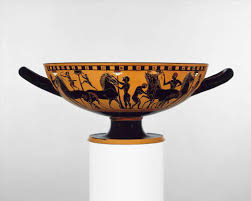
Mendelsohn, by the way, argues interestingly that the famous phrase about ‘the wine-dark sea’ is an overly poetic translation that is less accurate to the literal text; and that his ‘wine-faced sea’ alternative captures better the nuance of the Greek roots oinos (wine) and ops (face or eye).
He argues this better reflects the shifting, iridescent nature of the sea in the original text, which can range from the dark hues of a fine red wine to the transparency of a light white (rosé is not mentioned, but may have been considered too girly for Homeric warriors).
.
And as to why Christopher Nolan is so keen on Emily Wilson? The production has been bending over backwards to hit diversity targets – like casting Lupita Nyong’o as Helen, which has incurred the wrath of Elon Musk, so can only be a good thing – and recommending a female translator may all be part of that piece. And of course, the more female translators, the better; but that doesn’t automatically make their work good.
For one thing I do absolutely commend Emily Wilson; for not shying away from the fact that the quaintly named ‘handmaidens’ of previous translations, serving those appetisers without which, as Homer constantly reminds us, no feast is complete, were in fact slaves, and should be described as such. Which makes their brutal massacre at the end by Odysseus and his son Telemachus even more shocking. But is also a reminder that the ancient world was very different from ours, and any attempt to homogenise it, in verse-form or modern attitudes, can only be deplored.
In the battle of the translators, there are of course no clear-cut victories; one reader’s Achilles may be another’s Patroclus. What they do help make evident is why Homer matters so much in the first place, and is certainly worth fighting for.
Lovely piece. Any room to add Dan Stevens reading the lush old Fitzgerald version?..He did the dancing feet of the hanged girls of Penelope’s court best ….for me. I can’t renounce it.
Bravo