As the season gets going, Hugh reflects on how skiing has changed and the little-known resort in Austria he has come to love: St. Johann in Salzburg
I have a Good Skiing Guide from 1988 which has come to have a nostalgic quality: ‘Top Racer Martin Bell Describes Famous Downhill Courses’. It lists the essentials British skiers travelling to the Alps should pack, as if a survival mission on which many might embark but not all would return: a hip flask (in case the St Bernard doesn’t find you), first-aid box, sewing kit and, of course, Swiss army penknife.
Back in the day, skiing could be hard work. Threadbare waterproofs, unforgiving boots and skis that were so long – ‘an arm’s length above your head’ – you needed a turning circle for a truck.
How much has changed. Chair lifts now have heated seats and tinted windscreen visors, with light installations to show you precisely where to put your feet before lift off. Button lifts are a rare curio, a relic of the days when, as my son likes to point out, I was probably listening to a Sony Walkman while skiing. And the technology of skis has advanced to the point, instructors say, they should do all the work for you, as you sit in custom-moulded boots. That’s not quite true of course, sadly. Some operator skill is necessary. But carving skis can be very forgiving.
There have been safety improvements too. Helmets are ubiquitous, introduced by snowboarders – some would say made necessary for everyone else by snowboarders and their tendency to hit people. Mobile phones work on the slopes, useful for moments when your younger son decides to ski down to a lift that is already closed and from which the only way to get back is ignominiously strapped to a snowmobile.
What is it I like so much about skiing? Nothing to do with meeting any challenges or getting down a particularly difficult run. It’s being absolutely in the moment, concentrating completely on the snow and the lie of the mountain, and letting the kinetic energy from the ground travel through the skis.
Surfing is the only other sport that comes anywhere near the kick of letting the natural energy of the Earth surge through you. The fact that skiing usually takes place in the most beautiful of mountain landscapes helps as well. After a week in the Alps, I can feel my lungs breathing more clearly and purely, even if my legs feel as if pulverised by a Swedish masseur with a hangover; and yes, you should do some squats on a regular basis before you go, which is what I always tell myself without following my own advice.
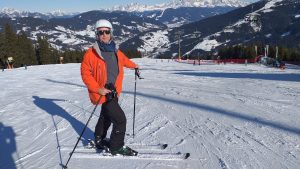
After roaming the Alps, I’ve settled on an Austrian resort, St. Johann in Salzburg (sometimes known as Sankt Johann im Pongau) as my favourite. ‘Where?’ you might ask. ‘Never heard of it.’ And that’s the point. It isn’t well known, with the cachet of Kitzbuhel, Lech or Zurs, none that far away. But you pay a lot for a resort to be well known.
Part of St. Johann’s appeal is that it forms part of the vast ‘Ski Amadé’, a linked system with sister-towns Wagrain and Flachau that makes for the largest ski area in Austria. It’s just an hour by train from Salzburg.
As an old market town rather than tourist village, Sankt Johann has a life of its own and normal prices, even if, unlike Zermatt, there is no sushi bar or jewellery shop for oligarchs. Instead, the community have started up a farmers’ market, with cheese and dried ham from the local area, and bio-yoghurt so fresh it could have skied down from a chalet. There are plenty of shops for those wanting a traditional trachten waistcoat with bone buttons; although even the promise that the lederhosen are ‘butter-soft’ should not stop you thinking about whether you would really wear them down a British high street.
Once up on the mountains, the skiing is spectacular for beginners and intermediates: wonderful long red runs, with challenging off-piste opportunities for those who need that sort of thing. The average British skier will be well satisfied. Come out of season and queues are satisfyingly short.
Digital skiing apps reveal that on our last trip we averaged 20 miles of piste a day, taking us far and wide but still not exhausting all the possibilities. There is a further efficient linked system of free buses which takes you round the whole Ski Amadé area to charming resorts like Grossarl and Bad Hofgastein.
This is North Austria, and helpings in the mountain restaurants come large and farm-sized. Specialities include Käsekrainer, a sausage stuffed with cheese, not for the faint-hearted, and Käsenockerl, a sort of macaroni cheese served in a hot griddle pan. Desserts come mit schlag, ‘with whipped cream’, as standard. Those with lighter appetites might prefer the excellent noodle soups. One mountain hut owner tried to sell me ‘a dumpling made out of the lungs and liver of a cow – you’ll love it.’ Reader, I passed.
There’s something about skiing in Austria I’ve always liked. Of course there will be painful moments. Only the Austrians can wear lilac and apricot salopettes with lime piping, and some of the music played for the largely German clientele from Munich could drown out Eurovision.
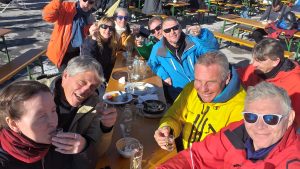 But where else do they hand out schnapps for free to give added zip for that final run home? Or where for 3 euros you can get a delicious home-made apfelstrudel with wafer-thin pastry – ‘mit schlag’ of course. By comparison, they do say the only time you see anyone smile in Switzerland is when you’ve arrived just too late for their lift.
In the past you could always tell British skiers. The first on the lifts and the last to descend, desperate to spend as much precious time on the slopes as possible – preferably without spending a fortune. The ‘pique-nique interdit’ signs in French ski restaurants were introduced to stop British families getting out the sandwiches they had made in their chalets. Or the chalet girl had made for them.
So if doing a modern list for a skier to take, what would I include? Not M&S sandwiches. My big discovery has been hypotonic fluids, like Dioralyte (other name brands are available), which work so well for cycling and even better in the Alps, where sun, altitude, alcohol and walking around in heavy ski gear can lead to insidious dehydration without noticing it. And Brits rarely bring suncream, thinking it’s too cold; mountain sun burns – a peeling and blistered red nose is not a good look.
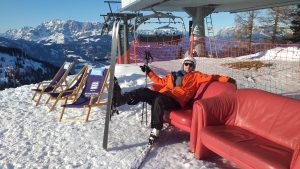
Most important would be a kickback attitude. The Austrians have red sofas and deckchairs at the top of many lifts. Use them and take five to absorb the view. And try to leave time for that extra portion of Apfelstrudel mit Schlag once you’ve worked up an appetite on the slopes.
———————————–
A modified version of this article first appeared in The Oldie