
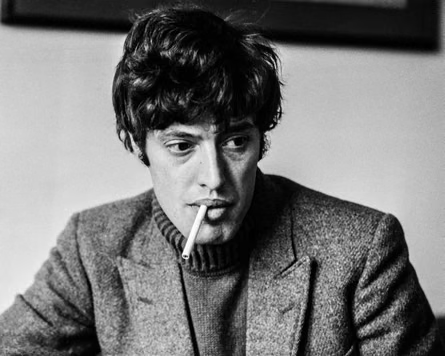
 Hugh Thomson interviewed Tom Stoppard twice – which amused Stoppard, as few people ever got the chance at all with a writer who famously valued his privacy.
In 1980, I saw Tom Stoppard give the annual Clark Lecture in Cambridge.
The Clark Lectures are usually sedate and resolutely formal affairs, in which an academic or man of letters is invited to opine. TS Eliot delivered a famous one back in his day.
Stoppard began his standing at the customary lectern on stage at the ADC Theatre, with the curtain behind him.
He was talking about how performance can alter the interpretation of a play and gave as an example the moment in Travesties when Lenin’s secretary opens a new Act with an exposition on the progress of the war in Russia. It is a long monologue for an audience to digest, and had caused problems for both the initial London and New York productions.
But the French producers telegrammed to him to say – a telegram was still a thing then – that the play was a huge success in Paris, particularly that scene.
He had not been present for the French rehearsals or opening night and hurried over.
‘And this,’ he said, ‘is how they played that scene with Lenin’s secretary.’
To the considerable surprise of his audience at the ADC, the curtain rose behind him to illustrate a set dressed for Travesties. Lenin’s secretary had been in bed and now emerged naked to slowly dress herself as she gave the speech about the political progress in Russia.
As a way of playing the scene, it had clearly been a coup de théâtre in Paris. And it certainly was in staid and puritan Cambridge. The actress playing Lenin’s secretary was Jenny Hall, Sir Peter Hall’s daughter, then an undergraduate and leading light in Cambridge’s dramatic world; and someone I knew, not that I knew she was going to do this.
Stoppard loved the reaction. An audience expected one thing – both in Paris and in Cambridge – and got another.
I had met him some years before when he had come to my school, and I had been chosen as a boy interested in literature to interview him on stage, before an audience of not always sympathetic schoolmates (17-year olds are a tough audience).
But Tom had been the easiest and most delightful of interviewees. I think I only managed three questions, which were more like prompts to allow him to riff away on whatever he chose. Although I realise now that it may also have been to avoid me asking any clumsy personal questions, which he hated, and spare my embarrassment when he refused to answer them. I got a laugh from my audience when I addressed him – cheekily if democratically – as ‘Tom’.
And then, many years later, he helped me when I was making a documentary about Oscar Wilde for the BBC. Again he talked eloquently and at length, this time on Walter Pater and his aesthetic influence on Wilde. I noticed an effect I experienced several times when talking to him; and often in his plays as well. That the fluency of his exposition meant I felt I was surfing the wave with him through often recondite philosophical waters – but that as soon as he stopped, I was left floundering, unsure quite what he had said and whether I would be able to still understand it when he – or his characters – were no longer speaking.
As it turned out, he was difficult to include in the film because his answers were long and intricate and interesting rather than short and concise, which is what television demands.
He got me to send him the complete version of my series, Dancing in the Street, as rock and roll was a fascination of his and something about which he was knowledgeable – as revealed in his Rock’n’Roll play about the effect of the music on Czechoslovakia (and, through Syd Barrett, on Cambridge). This caused the only argument we had, when I teased him for including a Guns and Roses track, as I thought it was naff, and he reacted badly. ‘You’re a snob, Hugh.’ Which stung.
The final occasion I heard him talk was at the Jaipur Literary Festival a few years ago when he talked about how, as a young cub reporter, the Bristol Old Vic had made a mistake and gave him press tickets for every night of Hamlet, not just the opening one. So after a week of solid performances, he felt he was inside the play and hearing voices, which resulted ultimately in Rosencrantz and Guildenstern, still for me one of his best, along with Arcadia and Travesties.
I prefer his 20th century work. Critics complained that he was not personal enough and perhaps he listened and responded with pieces like The Real Thing and his final exploration of his Jewish roots, Leopoldstadt. But I liked the earlier plays when nothing was on display but his wit; and the wonderful screenplays like Shakespeare in Love, or his work on Brazil and Parade’s End. Personality – like drama – is a construct, particularly if you have been born Tomáš Sträussler.
An early press photo of him lying around in a hammock – which seems to have disappeared even from the capacious Internet – is the one that made me want to become a writer myself.
He was refreshingly resolute that a writer should be lazy until called into action by a need to work out what they really felt about something by writing about it. Not because they already knew the answer.
As Stoppard grew older, he claimed, the writing process grew no easier.
‘Each time I’m in this leaky boat I go through this ridiculous exercise of trying to remember how I got hold of the last play. And I never do remember,’ he is quoted as telling one interviewer.
‘I cannot remember now how I got into Rock’n’Roll, I wish I could, I’d do it again. But in the absence of anything to go on I just sort of read the papers, chat to people, hang about and worry about it before I go to sleep.’
‘The Text and the Event’ lecture is anthologised in Tom Stoppard in Conversation