A warning against making too fashionable a decision when choosing a translation of ‘The Odyssey’.
So you’ve bounded out of Christopher Nolan’s Odyssey high on aristeia, prowess in war, and philotimia, the love of honour. And now you want ‘to read the book’, which you’ve always meant to do and never quite got around to. You’ve heard that Nolan himself recommended Emily Wilson’s recent translation; and the buzz is all about that on TikTok. The Guardian loves her. She’s the first woman ever to have translated Homer into English, so it’s got to be good, right? (the ‘into English’ qualification is needed because women have done it into other languages). Your finger is reaching for the Kindle button or maybe you’re sticking to old fashioned print and you’re heading to a bookshop.
The BBC needed to appoint a visionary at a time of crisis. Instead they’ve appointed someone who is now starting as Director-General with no experience of broadcasting or journalism whatsoever.
Back last summer , I was the first to call publicly in print for Tim Davies’ resignation as BBC Director-General after his abject failure over a whole series of managerial cockups – and pointed out in the Spectator his complete lack of credentials for the job in the first place, given he had never made a programme. The only creative decision he was said to have ever made was to have told Pepsi to turn their cans from red to blue when he had been a PR executive; advice which failed, as sales did not increase.
He went within months – I can’t take any credit, as I suspect he is more likely to read Marketing Week than the Spectator – but in the usual way of the BBC, it’s taken until now to replace him. It’s never been an organisation to have a sense of urgency; only those who have worked there, like me, can appreciate the institutional inertia at management level, where executives can play musical chairs all day long without ever making a decision about the direction the organisation needs to take.
Today, after all the vacillation, a new Director-General is finally starting in his place.
So, given the crying need for a strong figure who can lead the BBC into licence renewal against a declining share of the viewing figures, who have they chosen? …
So people have been stopping me in the street to ask why I haven’t been doing my usual annual BAFTA updates on what are the best films to watch in the winter months.
And the reason is simple – there haven’t been a lot of them ! And as one of the many voters, I’ve had to trudge through a fair few.
The big number blockbusters like Sinners, One Battle After Another, let alone ‘Wuthering Heights’ – with those coy quotation marks to show that it’s just a ‘version’ of the original – have been full of sound and fury signifying nothing. And don’t get me started on Avatar.
There have been a few quieter films that have slipped through. Pleased to see Sentimental Value has done so well and is in the running for best film at the BAFTAs and up for lots of other awards. It’s not perfect – there are some scenes that are unintentionally funny for being a little too Nordic and Scandinavian serious – but it’s at least a grown up film about real people.
“a brilliant performance by its 7 year old star, Lexi Venter”
As often happens, the best film of the year isn’t up for any awards at all. Don’t Let’s Go To The Dogs Tonight, based on the brilliant memoir by Alexandra Fuller, is a pitch perfect film with a performance by its 7 year old star, Lexi Venter – on screen in almost every shot -that should have had her up for a best actress award if there wasn’t such a bias against child actors. As Wendy Ide of the Guardian, one of our best film critics, commentated, it’s bizarre how this got no awards notice, but maybe they just didn’t have the publicity machine you need these days –which let’s remember was invented by Harvey Weinstein when he wanted to promote his Miramax films for box office enhancing awards. And also it doesn’t tick any of the right diversity boxes in that it’s about white trailer trash in what was then Rhodesia, although it actually says more about ingrained racism then many a more right-on film.
.
Embeth Davidtz wrote, directed and stars as the girl’s mother, and is clearly a talent to watch.
‘But is there a good popcorn film this year?’ you ask.
I really enjoyed Frankenstein or at least the first half which is just about the mad inventor – another terrific performance by Oscar Isaac which has gone under acknowledged in the awards – and actually gets less interesting once the monster appears. Certainly it should clean up for cinematography and production design which are extraordinary – no surprise from the director of Pan’s Labyrinth.
And Steve has the most integrity of just about any movie out at the moment with a terrific performance by Cillian Murphy and ensemble acting by the troubled borstal boys.
Be great if such lower budget films as Steve and Sentimental Value do well as it might persuade Hollywood you don’t have to be bombastic to succeed. Roll on the awards this weekend. And happy viewing ….
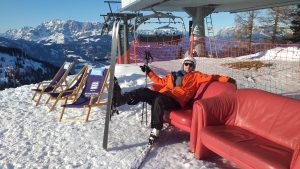
As the season gets going, Hugh reflects on how skiing has changed and the little-known resort in Austria he has come to love: St. Johann in Salzburg
‘Most important would be a kickback attitude. The Austrians have red sofas and deckchairs at the top of many lifts. Use them and take five to absorb the view.’
I have a Good Skiing Guide from 1988 which has come to have a nostalgic quality: ‘Top Racer Martin Bell Describes Famous Downhill Courses’. It lists the essentials British skiers travelling to the Alps should pack, as if a survival mission on which many might embark but not all would return: a hip flask (in case the St Bernard doesn’t find you), first-aid box, sewing kit and, of course, Swiss army penknife.
Back in the day, skiing could be hard work. Threadbare waterproofs, unforgiving boots and skis that were so long – ‘an arm’s length above your head’ – you needed a turning circle for a truck.
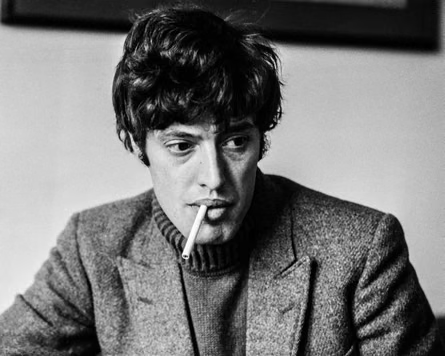
Hugh Thomson interviewed Tom Stoppard twice – which amused Stoppard, as few people ever got the chance at all with a writer who famously valued his privacy.
In 1980, I saw Tom Stoppard give the annual Clark Lecture in Cambridge.
The Clark Lectures are usually sedate and resolutely formal affairs, in which an academic or man of letters is invited to opine. TS Eliot delivered a famous one back in his day.
Stoppard began his standing at the customary lectern on stage at the ADC Theatre, with the curtain behind him.
He was talking about how performance can alter the interpretation of a play and gave as an example the moment in Travesties when Lenin’s secretary opens a new Act with an exposition on the progress of the war in Russia. It is a long monologue for an audience to digest, and had caused problems for both the initial London and New York productions.
But the French producers telegrammed to him to say – a telegram was still a thing then – that the play was a huge success in Paris, particularly that scene.
He had not been present for the French rehearsals or opening night and hurried over.
‘And this,’ he said, ‘is how they played that scene with Lenin’s secretary.’ …
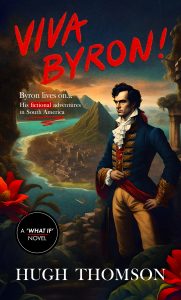
What would have happened if the poet Lord Byron had not died an early death in Greece?
But instead had lived – and then some – by doing what his letters show he always wanted to do: escape to South America with the great last love of his life, Countess Teresa Guiccioli, and help Simon Bolivar liberate it from the Spanish.
This great sweep of a novel imagines just that and takes the poet and his lover into a New World of the Americas where nothing is ever quite as they expect.
‘Bold, bewitching and a touch dangerous – like Lord Byron himself’ Benedict Allen
‘Hugh Thomson is a mesmerising storyteller’ Sara Wheeler
‘Literally fabulous! Unmissable…’ Joanna Lumley
So if anyone’s wondered what I’ve been doing during the extended radio silence it’s because I have determinedly not been doing any other activities other than getting this novel finished!
Which has involved travelling to Colombia to research it and the usual amount of concentrated work…
But I’m very pleased with the result and I hope that all my readers feel it’s been worth the wait.
Why the rest of Britain might want to leave Scotland
I was at dinner recently with a distinguished Fellow of All Souls who had served as a politician and is known for his incisive analysis. The conversation turned to Scotland and their forthcoming elections.
With some relish, my companion, English like me, listed the multiple reasons why the Scots should not want to leave the Union.
They would have problems with their currency. The Europeans would not want them back. Under current arrangements, they were considerable nett gainers from Westminster; independence would see their trade and incomes diminish. And would Shetland or Orkney then want to secede from Scotland? Or for that matter would some of the border constituencies reconstitute themselves, like the six counties of Northern Ireland, and want to reattach to the United Kingdom, with all the attendant tensions that have occurred in Ulster?
As much to stop him in his tracks as anything else, I asked him if he had ever turned the issue on its head. If the Scots enjoyed so many advantages by being part of the Union, what exactly did the rest of Britain gain by keeping them? If they wanted to go, and certainly if they voted to go, wouldn’t we be better off by just cutting them loose? Surely there was no logical or rational reason for wanting to keep Scotland in the Union, other than the very debatable merits of maintaining a nuclear base at Faslane? …
As the Americans prepare to leave Afghanistan and here in Britain we hold a Defence Review, have we learned the lessons of our own failures there?
Lockdown has given me plenty of time to reflect and I’ve been thinking recently a great deal about Afghanistan – perhaps prompted by the fact that the Americans may be about to withdraw completely from that country after 20 years of largely unsuccessful occupation since the invasion.
I was in the country for a brief and intense time in 2007 when I was filming for Channel 4 Dispatches and CNN. We saw a country that had been brutalised for decades by the Russian occupation, the ensuing civil war and then the American carpet bombing to ensure that their troops met no resistance. And a country which was becoming restive as the Allies seemed increasingly unable to help them rebuild, or for that matter interested in doing so once they had been distracted by Iraq. …
‘Well that’s you shafted,’ said one friend kindly at the start of the worldwide lockdown. ‘Not a good time to be a travel writer…’
Well yes and no. Obviously there’s not much actual travelling possible at the moment. But then the ratio in travel writing between the former and the latter has always been grossly disproportionate – too little time spent travelling and far too much time having to write about it when you get back.
And in my case I only did just get back. I was writing a piece about the sunny beaches and boho resorts of northern Uruguay – one of those gigs which leads to envy and resentment, particularly in March – when they introduced the sudden guillotine on air travel, so we had to slip over the border to Brazil for one of the last flights back to Europe. I was travelling with my girlfriend and for a moment we thought of just staying, as there are worse places to self-isolate than a low rent beach hut in the sun; but while this sounded fun for a while, if the worldwide lockdown continued for months it might have become restrictive and complicated. Wiser counsels prevailed. Which is lucky as otherwise we would still be there. …
The suggestion in the BBC Plan that BBC4 is to stop making new programmes and become a largely repeats-only channel, possibly only accessible online, is a depressing reminder to viewers of a very long-term trend.
Oh dear. Whatever happened to television? And in particular, the area that BBC4 was particularly supposed to promote – factual and arts television. The channel that was launched with the slogan, “Everybody Needs a Place to Think”. Has the BBC decided that they no longer do?
Or rather, that it is not for them to provide it, when they can concentrate on ‘youth programming’ like BBC3, with the assumption patronising to both young and old that serious factual programming is only for the elderly.
Time was when working in television was to work in one of the most exciting industries around. I certainly found it so. …
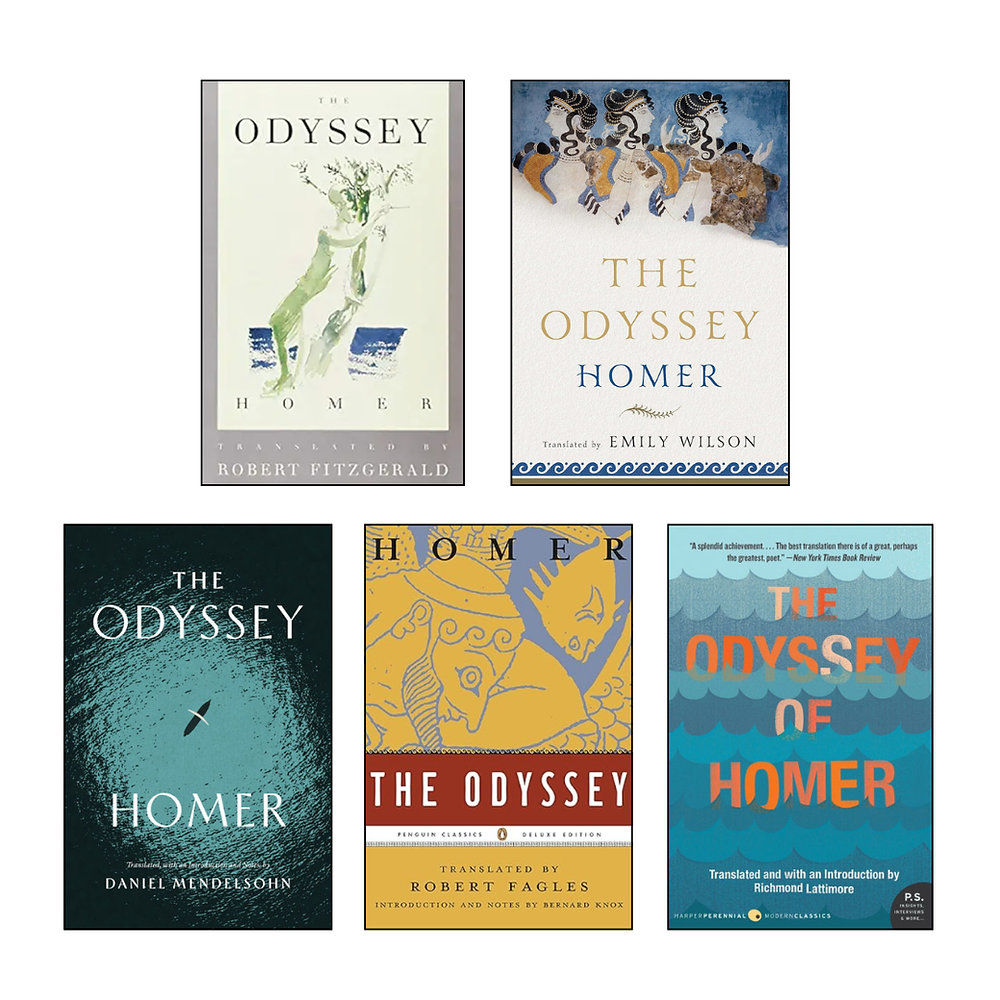 A warning against making too fashionable a decision when choosing a translation of ‘The Odyssey’.