Another dissolute memoir which turns out to be a travel book in disguise. It seems only a few weeks ago that I posted on Howard Marks’s High Times (no I wasn’t referring to mine…). But I have a particular interest in ‘Life’, this autobiography by Keef (I had never realised this was a self-appointed nickname): before publication his managers had been talking to me about possibly directing the forthcoming documentary that will complement the book. Talks went on for a while but were then blown out of the window when Johnny Depp said he wanted to do it as his first directing job – clearly rather a better name to have over the marquee and an old friend of Keef’s anyway.
.
Life is fun – some good stories told with the trademark louche bonhomie, either travelling through the Badlands of the southern States or downtown Kingston. And one of the most memorable passages is when he takes us to Morocco, Tangier and Marrakesh for a key moment in his story, the love affair with Anita Pallenberg when she leaves Brian Jones for him, almost pulling the Stones apart in the process.
Someone has to make it into an opera – the beautiful but tempestuous boy (Brian), the beautiful and even more tempestuous Anita (“she certainly made a man out of me”) and Keith himself, the picaresque hero, with the story played out against a sixties Morocco that he describes well — the kef and hash, the orange trees, the sheer alien nature of the place just a slip of a way from Europe (“it could have been 1000 years ago”).
As it still is. I have been over to Morocco three times in the last year and it never ceases to amaze me how such a wild country can be just a few hours on a no-frills flight away (Ryanair from London Stansted).
But one particular moment in Keef’s travels particularly intrigued me – when he fetches up in, of all places, Urubamba, the small town in Peru where I lived with my family five years ago, as recounted in Cochineal Red: he and Mick have to sing for their supper (and a room for the night) as no one knows who they are.
It’s a story I’d heard when staying in Urubamba but always discounted as one of those tall stories. Sure the Rolling Stones came here and played here in the small corner cafe on the square. Pass the Inca treasure will you…
There’s something about a lock gate opening that always excites me, the admission to a new territory, whether it’s a stretch of the upper Thames or in this case the opening of the locks to the most ambitious canal in the world, that of Panama.
The fact that it’s dawn and pelicans and frigate birds are circling round us as steam rises from the jungle to either side just heightens the sensation. The red and green navigation lights are blinking to either side as we nudge our way down the channel towards the gates, and there’s an appealing pinging noise made by the mechanical ‘mules’ (electric carriages on tracks) that escort us on the shore.
Even though we’re in a 650 foot long boat of 32,000 tons, the procedure for entering the lock is charmingly simple in some ways. Two men come out in a rowing boat to grab some tow ropes which can then be pulled along the sides of the lock to guide the boat in.
The ropes are thrown down from the boat by a local team of pilots who come on board. It’s quite an art to hit a rowing boat with a rope from a distance – not least when you have a great many idle spectators to comment if you get it wrong – and on the side of the lock they’ve set up a bull’s-eye and throwing pitch so they can practise in their downtime.
container ship travelling through Culebra Cut
Approaching from the Caribbean side, boats have to rise about 85 feet to reach the large inland lake of Gatun, man-made and created by flooding the valley, which we will then cross before taking the infamous Culebra Cut through the hills – infamous because so many men died making it – and then emerge through further locks into the Pacific on the other side.
While still, almost a century after it was completed, one of the great engineering marvels of the world, the moonshot of its day, I find it hard to forget the lives that were lost building the Panama Canal: a quite staggering 25,000, most of the deaths occurring during the failed earlier French attempt of the late 19th century when they had yet to get the measure of the challenge — in particular the need to provide sanitation and rid the area of the standing water in which yellow fever and malaria mosquitoes could breed.
The French used many Chinese labourers and refused to let them take their habitual opium, about the only thing which had kept those same labourers going when working on the North American railroads. As a result many ‘fell into a perpetual melancholy’, as one observer reported, and some committed mass suicide at the Culebra Cut.
The real killer was of course yellow fever, from which only some 30% of those infected were likely to recover.
The whole affair was a débâcle of the first order. The French instigator of the canal, de Lesseps, a national hero for having completed the Suez canal earlier, badly underestimated the nature of the task – cutting a canal not through malleable desert sand but through some of the most humid jungle in the world. When they abandoned their attempt, it was not only national pride that suffered: the French economy nosedived after the earlier hyping of shares in the ‘ Panama bubble’, and because de Lesseps was Jewish, an atmosphere of anti-Semitism was fermented that prefigured the Dreyfus affair.
But the waters of the lake are placid now. There’s an island that has become a bird sanctuary and the transition to Panamanian control that was completed some 10 years ago has been a success – to the extent that they are now widening the channels so as to be able to take larger tankers. When first opened in 1914, the Americans ‘future-proofed’ their fine new canal with channels of the then phenomenal width of around 100 feet – allowing boats of what became known as the Panamax standard – some 85 feet wide – to squeeze through. But there are plenty of larger supertankers that have to take the long route around Cape Horn, adding 8000 miles to the trip , so are in the market for a wider canal.
All this comes naturally at a price – around $50,000 passage fee for a boat like ours. Not that I’m paying it. But it does justify drinking champagne at six in the morning as we float up and enter the final lock gates that allow us onto the lake.
Been sailing along the Cuban coast – although I’m in a powerful boat, the island of Cuba is so long (getting on for 1200 kilometres) that it has taken us 24 hours to sail along the shore before we head south through the Westward Passage and towards the Panama Canal.
Seeing the lights of Cuba twinkling alongside us at night, I’ve been remembering some wonderful times I had at each end of the island in the past — both in Havana to the west but also in Santiago de Cuba right in the far east, the Cuban Oriente, home of son and so of salsa, and a place like New Orleans which is just busting out with dance, music and musicians wherever you look.
.
Perhaps oddly it also makes me think of Bob Dylan. Why? Well I constantly play him anyway when travelling and I’ve just been reading an intriguing new book, Dylan in America by Sean Wilentz, which is a reminder of what a musical magpie he’s always been – sometimes controversially as in recent years he’s been accused of plagiarism, which is as absurd as accusing TS Eliot of doing the same in ‘The Waste Land’.
It helped me realise why he likes The Clash so much that he played ‘London Calling’ (to my great surprise) at the last concert he gave at the O2 – a song completely unsuited to his voice but very suited to the rough rock ‘n’ roll quality of the Hawks-like backing bands he now favours . Perhaps it’s because The Clash, like him, are just such musical magpies who pick and choose from a huge variety of musical styles, and also viewed themselves as the troubadours and custodians of a whole range of styles of older music, from ska to rockabilly to the whole Sandinista library.
What’s this got to do with Cuba given that ‘Dylan does salsa’ is almost as unlikely a thought as ‘Dylan does a Christmas album’ (except that did actually happen and in fact Dylan has often strayed south of the border, ‘lost in Juarez and it’s Easter time too’, with Latin touches to his music and facial hair – that gaucho moustache). Cuba too is an extraordinary melting pot of musical styles, far less homogenous than people suppose. Santiago in the east regards itself as the musical heritage city, again much like New Orleans, with an authentic earlier form of son which was later much adulterated and commercialised in Havana by the nightclub owners and pre-revolutionary Batista American gangsters who ran the place.
The American State Department is contemplating relaxing the current stringent restrictions on American citizens visiting Cuba. What better way to celebrate this if it does happen than for Dylan to play Santiago de Cuba as the first visiting American musician? Probably one of the last places in the world he hasn’t played yet on his ‘everlasting tour’ and sure the Cubans would take him to their very large hearts as un músico con corazón e alma y cojones. I’d love to be there to shake a tambourine.
Wonderful to have a white Xmas. My children, nephews and nieces all went sledging with me down a hill in the Chilterns at great speed – and is there anything more beautiful than travelling across England on a sunny day when it is completely under snow, as it was on Christmas Day?
That said, the ‘weather events’ of the last few weeks have left me wondering if we have lost the ability (or humility) to know when not to make the journey. Are we so used to being able to “beat nature” and control it that when clearly uncontrollable forces arrive we still try to soldier on when the wise course of action would be to beat a retreat?
I noticed this when caught myself in a whiteout blizzard on the M25 as it crosses the North Downs in Surrey. We think of suburban Surrey within the M25 ring road as being about as tame as England gets; but the hills of the North Downs collect the first wave of any incoming north-easterly snow and can fast turn into a bleak and hazardous environment.
On this occasion within just 20 minutes the scene looked like something out of the German retreat from Moscow: heavy lorries lumbering to a standstill (400 ended up parked on the hard shoulder overnight), visibility down to a few yards, the slipways icing up so that it was only with extreme difficulty that anyone could leave the motorway at all. …
Literary launches are often dull affairs — dutiful publishers, respectful friends, bashful authors — so very agreeable to be invited to the Granta launch for their new ‘best of’ list of ‘young Spanish language novelists’ – in Granta 113. Someone (Saskia Vogel) has had the bright idea of combining the reading with a professionally hosted wine tasting so that each writer is paired with a fine Spanish vintage. As punters are only given one glass, this means they have to drain it between each reading to get a refill. Result? A happily inebriated audience who appreciate every last word that the writers feed them.
.
And the writers themselves? Granta make much of the idea that this new generation (i.e. born after 1975) have not experienced the repression of Franco or the Latin American dictators, so write more of the personal than the political. This perhaps oversimplifies the work of the older generation – like Vargas Llosa and Márquez – and also ignores the work of some of the finest young Peruvian writers like Daniel Alarcón (Lost City Radio) and Santiago Roncagliolo (Red April) which is intensely political.
But they do have a point as it is true that one huge influence hangs over this generation and not necessarily a benign one: the late Robert Bolaño, who was been canonised by the literary world since his untimely death. Bolaño made a virtue of an autobiographical approach – what it was like to live as a writer in the Latin American bohemian world of casual sex and drugs – which in the hands of a master is all very well, but when played out in infinite variations by disciples can become introverted and dull. Writers have affairs and literary rivalries — fine . But give me Macondo or the War At The End Of The World for a bit of scale and vision. Both Alarcón and Roncagliolo provide that in their novels above, as do some of the others; the best of the work here is, to use one of Borges’s favourite words, nítido, lucid and intense (and very well translated), and as ‘viscerally real’ as Bolaño wanted South American literature to become. Granta are to be commended for their commitment in launching the project.
What is notable is the lack of women writers. All six of those reading tonight are men. And only a quarter of the total published list are women. This is not the fault of Granta, who have rightly selected just on merit not political correctness. But surely the next wave of Latin American writing will see far more from the likes of the remarkably accomplished Lucía Puenzo, who is both a filmmaker and writer.
Back to the winetasting, which should be developed further by other literary publicists: I’d like to see a vodka tasting with Martin Amis and Ian McEwan; champagnes with Howard Jacobson; and ‘Amazonian armpit arguardientes’ with Will Self.
Like everybody else at the moment I’m reading Jonathan Franzen’s Freedom.
.
There have been many references to it as being Tolstoyan in ambition, partly because of its length and scale – the intimate lives of his characters played out against contemporary events like 9/11 – and because the author references War And Peace himself once or twice in the text.
But I think it’s Tolstoyan in subtler, different ways: Franzen seems to have the same ability to slip in and out of different characters’ heads, particularly his female ones. Few male contemporary writers would dare to begin their book with a long testimonial from their heroine, ranging across issues from motherhood to sex to her fraught relationship with her own mother. In a way what Franzen has done very successfully is to take territory usually occupied by such brilliant North American female novelists as Alison Lurie (The War Between The Tates), Carol Shields and Anne Tyler and give it a male twist while preserving the intimacy of detail.
He’s also Tolstoyan in the way that when major events happen — one of his characters falls in love with someone they shouldn’t have, or someone dies – he just lets them occur baldly in the narrative rather than building up an elaborate scaffold of preparation, as a lesser novelist might do. What interests him are not the large stones dropping in the water but the ripples that they cast – and that while his characters may often rationally know what they should do (which man to marry, what not to say), events and random emotions may somehow compel them to do precisely the opposite.
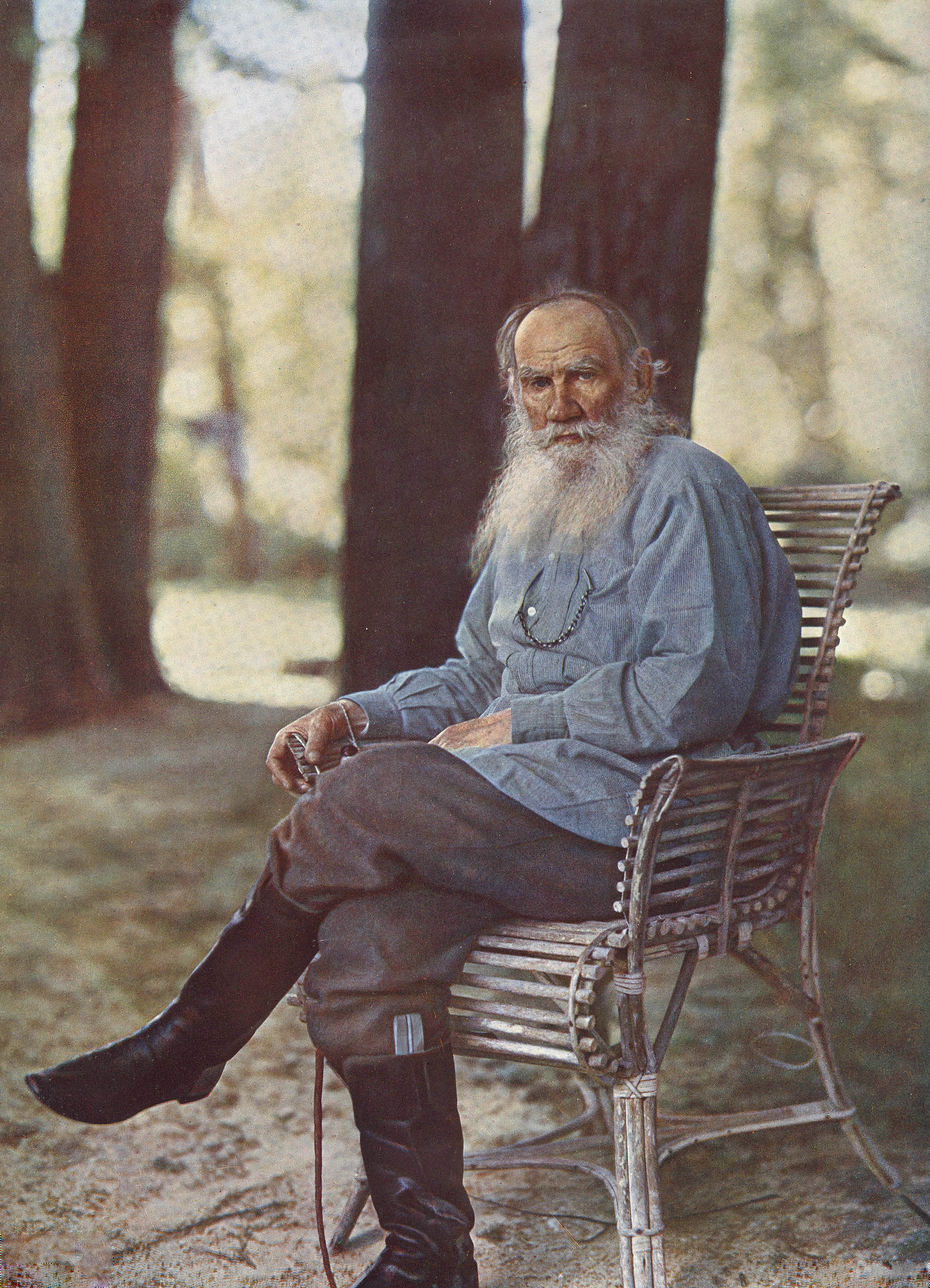
Tolstoy in 1908
Are there any British novelists achieving a similar scale over here? not that I can think of – although there is another question that interests me perhaps even more: are there any that would want to? There is still a modernist agenda here which values formal ability – of the sort that David Mitchell for instance has so dazzlingly displayed – over the slow unweaving of characters’ lives against an uncompromising historical background of the sort that Tolstoy would recognise.
Not that Tolstoy, at the time of the centenary of his death (November 1910), is that much of an influence still in Russia itself: when I asked a young Russian novelist in Moscow whether his generation viewed Tolstoy as an influence, he laughed and asked, quite fairly, whether Dickens was still an influence in Britain. Although the fairer comparison might be George Eliot….
I’m both exhausted and exhilarated by the end of proceedings. The final poets’ dinner on Sunday night ends at about two in the morning.
If there has been a noticeable intensity at Aldeburgh compared to other poetry festivals, it derives from one unusual component — no poet is ever invited back.
This isn’t because in some ways they might have failed a quality threshold. A strict policy is in place only to invite those who’ve never read there before. This lends the proceedings an intensity they would not otherwise have. Poets have one shot at getting an Aldeburgh Festival reading right.
The same goes for the organisers. Every year they have to start at the bottom of the mountain and select new participants.
I’m reminded of those Buddhist monks who spend months laboriously making sand mandalas from small grains and then blow them to the wind.
.
Sunday 18.00 Don Paterson’s earlier lecture on Frost proves a terrific curtain raiser for the later reading by Marie Howe, as it is noticeable how many of her poems are framed as dialogues rather like Frost’s. The elegy for her missing brother is just one of many fine poems.
She makes a striking figure on stage with her Botticelli hair. Indeed this year’s ‘best poetic hair’ prize is awarded equally between her and the long-locked Matthew Caley. I’d love them to do a shampoo ad double-act together, swinging their impressive tresses as they duetted on a country and western song, or pastoral eclogue. Who says that all poets are bald and need to wear berets?
Bill Manhire is less hirsute but still very effective. He concentrates on those works of his that lend themselves to public performance, with strong rhythm and rhyme. You might think that most poets would follow this obviously sensible line. Or series of lines. But they don’t.
His elegy for Charles Causley is just the first of a string of emotionally intense poems, hypnotically delivered. His voice has an attractive incantatory quality, whether listing his possessions as a small boy on New Zealand’s South Island, or howling at the moon down a lift shaft in Copenhagen.
The perfect choice to close the festival, internationalist, accomplished and passionate as it has been.
.
Sunday 14.00 I’ve had 2 cups of 152’s excellent cappuccino and so am ready for the highly caffeinated lecture on Robert Frost by Don Paterson. We are still at warp speed and every word is worth unravelling and playing back at 33 rpm.
The bulk of his lecture is on Frost’s poem ‘West-Running Brook’. While some critics have decried the rhetorical staging of this as a dialogue between husband and wife as clumsy, Don admires what he sees as the resulting subplot of ‘how people in love talk to one another’. Perhaps naturally, given that he has just published his account of Shakespeare’s sonnets, he finds Shakespearean echoes in some lines – like ‘And even substance lapsing unsubstantial’, while also being drawn to Frost’s nihilism and ‘the aphoristic, demotic and plain-speaking nature of his verse which omits the extraneous, leaving itself nowhere to hide’.
He sees Frost’s poetry as ‘an intellectual and emotional provocation to which we are challenged to respond in kind’. The same could be said of Don’s rigorous criticism.
Not quite sure about his pronunciation of ‘contraries’ though. Surely to rhyme with ‘Compare-is’? Readers with New England accents are invited to write in……..
.
Sunday am It’s nine o’clock in the morning and I’m trying to move at speed to the White Lion to give my own talk on poetry and travel writing, together with Harry Clifton. Unfortunately the wind is so strong that for every two steps I take, I’m one step back, and there isn’t any music playing.
.
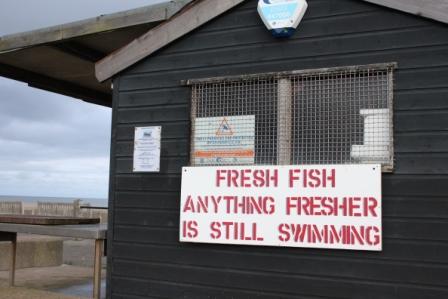
‘Fresh fish – anything fresher is still swimming,’ reads the logo on the side of the shack that sells them on the beach. I can’t quite say the same about myself, but at least I haven’t got a hangover, and Maggie at the Poets House has fed me plenty of black coffee and bacon sandwiches, so the brain has started to kick in.
.
Have 250 people gathered to hear us? Well not quite. But for early Sunday morning it’s a brave turnout, as Harry says. We talk about how when travelling some experiences seem to lend themselves either to prose or poetry; of how Byron was in some ways an early travel writer, appealing to the stay-at-home British public ( who had to stay at home – it was the middle of the Napoleonic Wars) with his tales of Mediterranean pleasures; of ‘The Odyssey’ as the first travel poem; of the celebration and exhilaration of travel but also of its own concomitant hangover, jet lag:
.
Jet Lag Blues
Two o’clock in the morning, punched inside out, jet-lagged from Los Angeles via London, face pressed against
the pillow with unnatural gravity, like a safe-breaker listening for the combination to give,
I feel the ground much closer, almost moving, and want to twist the world’s tectonic
spine, the way a chiropractor snaps a patient’s back, so I no longer lie divided on my own fault line.
.
The Aldeburgh Poetry Festival blog is sponsored by Writers’ Centre Norwich,a literature development agency for the East of England running workshops, competitions, events and more. www.writerscentrenorwich.org.uk
Saturday 23.30The evening closes in the way all Saturday evenings should close – with a drink and a stand-up comedian, in this case the brilliant Elvis McGonagall, whose tales of love, loss, and David Cameron are just the ticket. The man is a lyrical genius, managing to find not just one but two different rhymes for Oompa-Lumpa.
Outside they are still sending up fireworks for bonfire night. It’s been a long but satisfying day.
Saturday 18.00 By now I’m beginning to feel a bit like I’m travelling at warp-speed myself, bundling from talk to talk, with some blogging in between (Stardate 2011, Captain’s Diary… A strange poet with staring eyes has parked himself in orbit around me and is refusing to move….)
On to hear Marie Howe talk about one of her teachers and mentors, the late Stanley Kunitz. It’s a much warranted appreciation as he is less well-known in the UK than some of his American contemporaries such as Bishop, Lowell and Berryman. He died in 2006, age 101. He said of his later poems, “what is left to confront are the deep simplicities,’ and according to Marie he was working towards “an art so transparent you could look through it and see the world.”
She reads The Portrait, an extraordinary poem and very central to his work, which tells of the death by suicide of his father when Kunitz was very young, and quotes something that he told her when she was his student, that poetry should exploit “the lyric tension of the fact that we are both living and dying at the same time”.
It’s a good reminder of the Aldeburgh support for American poetry over the years, as Neil Ashley of Bloodaxe points out to me when I chat to him after one of the earlier readings. It was Aldeburgh who hosted Tony Hoagland a few years ago, who’s been emerging as one of the strongest American voices of recent years – certainly a favourite of mine – and whose most recent work, Unincorporated Persons in the Late Honda Dynasty, Bloodaxe have just published.
This year as well as Marie, Dorianne Laux has come to Aldeburgh from the States and has not only given a much sought-after masterclass on ‘how to write an unforgettable poem’, but has read several of her own which are just that. ‘Enough Music’, for instance, is a fabulous short poem.
Saturday 17.00 Some speed writing with Michael Laskey and Jeni Smith at the James Cable Room — the format feels a bit like bingo. Everyone sits expectant at a table, eyes down to pen and paper. Michael or Jeni reads a poem and sets a five-minute poetic task (like ‘Think of a sport. Write out its keywords. Make a poem’).
It’s fun and fast and goes down well with the participants.
Come back an hour or so later for a workshop that Don Paterson gives. If the earlier class was like playing bingo, Don’s is more like playing Speed Go on the Internet: extremely fast, extremely furious and demanding mental dexterity. Don is packing the lecture he usually gives in two hours into a half-hour firework spectacular.
He boldly takes us into what he terms ‘deep trope’, at warp speed. Some fascinating vistas flash by as we hang onto the spacecraft, metonyms and metaphors pinging off the side like meteorites. The search is for autopoiesis, a sort of Gaia-style self –renewing poetical equilibrium where content and structure both balance and renew each other.
In Star Trek it would be found on those planets that have to teach Kirk and his men some simpler truths (and don’t you just know that Spock would be the one to have a problem with metaphor).
Don makes some good points about the process of composition being one in which you only find out what you think as you start to write, rather than simply printing a received opinion; and that a poem has to intrigue enough on the first reading to bring you back for subsequent deeper ones.
.
Saturday 13.00
Some more fine readings this morning, this time from Harry Clifton and Imtiaz Dharker.
Harry talks about the way that for his generation Ireland was almost ‘painted too green’ by nationalists, from its letterboxes to its literature, in the decades after Independence and indeed for most of the 20th century. He himself has always taken a more internationalist approach, with much time spent abroad in places like Paris or Italy, producing an impressive body of verse. The Italian stay also gave rise to an excellent travel book, on the Abruzzi Mountains. We are giving a joint talk tomorrow morning on the connection between travel writing and poetry, but I’m not just being polite about his writing to ensure a smooth discourse: the qualities of elegant concision that go into his poetry lend themselves well to travel writing, which can sometimes be prolix.
There is an emotional undercurrent to the following reading by Imtiaz Dharker, who is replacing Selima Hill at short notice after Selima was taken ill. As the Festival announces,
We are hugely grateful to Imtiaz for stepping in at such short notice, and rather amazed at the extraordinary felicity of it all – given that Imtiaz herself had so sadly to withdraw from last year’s APF due to the untimely death of her husband Simon. We are all thrilled that she will, at last, get to enjoy the Aldeburgh experience.
Imtiaz gives a moving reading of “Honour Killing”, in which she takes off “the black coat of my country”, the veil, and the other garments that constrain the position of women in countries such as Pakistan. It’s a fitting rebuke to those Western intellectuals who have recently flirted with the idea that somehow the burka and its variants are in any way empowering, and that we just fail to understand it because of cultural difference. I made a film about the position of women in Afghanistan for Channel 4 a few years ago, so it’s a subject that I appreciate her strong feelings on.
And she makes the second good joke of the day: ‘ now that English is just one more Indian language….’
.
Saturday 10.30
from the programme:
Jubilee Hall 9.00 – 10.00am : DISCUSSION: THE POET’S TOOLKIT .
A meticulous eye for detail with an awareness of the bigger picture. Relevant experience. Excellent communication skills, verbal and written. Capacity to think outside the box. Passion, drive and ambition. Ability and willingness to work long and flexible hours unsupervised. Lars Gustafsson, Marie Howe, Bill Manhire and Don Paterson finesse the person specification.
9.00 in the morning? what time is that to start a Poetry Festival. One thing that rarely is part of a poet’s toolkit is the ability to get up early in the morning. But Lars, Marie Howe, Bill and Don seem fresh as daisies.
Don kicks off by trailing the notion that poetry is a bit like dyslexia, a condition of the mind that favours certain abilities while hampering others: he points out that many of the male poets of his acquaintance can’t drive, swim or ride a bicycle safely, however impressive their scansion. So “poetry is less of a calling and more like a diagnosis.” As poets we have less dopamine receptors, so as more information is allowed to reach our cortex, we become over-wired (and, the hope is, inspired).
Bill reflects that poets should be obsessed with words themselves, building up what Maori poet Hone Tuwhare once described to him as a ‘word-store’; Marie quotes Virginia Woolf’s essay on ‘The Angel In The House’, and suggests that women poets need to lose the notion of themselves as the constant ‘giver’ in a household, to become instead more feral: “there are dogs out at the gate — throw them some meat.” And as Lars astutely notes, ‘it’s all very well to think out of the box, but first you must make your box.’
Best joke of the morning comes from Marie Howe, who quotes what someone said about Rilke as he left a party: “does he have to be a poet all the time?”
.
The Aldeburgh Poetry Festival blog is sponsored by Writers’ Centre Norwich,a literature development agency for the East of England running workshops, competitions, events and more. www.writerscentrenorwich.org.uk
Friday late:It’s an attractive opening bill: the narrative directness of JO Morgan’s story about a wild boy on Skye; Matthew Caley’s louche rock ‘n’ roll take on Illinois, breast-feeding and Yeats (and claim that Ezra Pound used to lie at languorous angles on chaise longues so that his semen could seep down to his brain and improve his poetry); and then, to round it off, Don Paterson.
Writing one-line descriptions of poets for a programme is a bit like a wine critic’s job. Sooner or later you run out of adjectives. Once we’ve had thoughtful, acute, rigorous, playful, incisive and that old stand-by prize-winning, you have to start reaching for the unexpected.
Not quite redolent of hay on a mid-summer evening (though I can think of a few poets who would fit that bill) , but something ambitious.
Hats off then for the description of the wonderful Don Paterson who according to the programme shoulders the responsibility to live and write the fully-examined life with wit, courage and exemplary formal skill. That’s some day-job!
These days, Don hardly needs a strap-line under the billing, such is the impression that recent collections like Rain have made. He even has an ‘official website’.
If this were a rock gig it would be the Proclaimers, followed by the Dandy Warhols, followed by Tom Waits. Not a bad line up.
Indeed the night showcases all that is best about the Poetry Festival: poets reading well and with engagement to an audience excited to hear them. The Jubilee Hall as a space always has a sense of occasion. It’s big enough to make the performers onstage seem both vulnerable and intense; small enough for a sudden and surprising intimacy with them when the poems start.
It’s also a good moment to step back and appreciate what a formidable achievement the Poetry Festival is. Without now receiving a penny of Suffolk County Council money, it manages to keep an impressive wave of energy beating each year against Aldeburgh’s shingle shore.
But as Naomi Jaffa, the festival director, announces (“I’m going to do something very un-English: I’m going to talk about money”), with the current cuts on the horizon, it will need all its many supporters to rally round if it is to keep going.
All three poets read tremendously well. Don Paterson has learnt his by heart, and his reading brings out both the underlying emotion and rhyme in equal, carefully weighted measure. While apologising for the fact that he feels so much of his last collection dealt with ‘death and divorce’, he also reflects ruefully on the ageing process: ‘ one no longer appears in one’s own poems – one’s presence is more of a heraldic affair.’ And he now takes siestas, although as a longterm hispanophile, we would have expected nothing less of him anyway…..
He reads several more recent, unpublished poems, including some from a sonnet sequence that he is beginning (he is at number eight or nine out of a planned 48), He also reads ‘The Day’, inspired by the DVD box set of Battlestar Galactica, no less, with a conversation between two aliens who have just got married: it’s engaging, direct and funny, although the insistent little six-year-old boy inside me taps me on my shoulder at one point and asks, ‘ did that man just say the earth was a star?’
.
Friday 19.00John Glenday gives a modest and intriguing Craft Talk, on the art of revising, for which he is well qualified, running often to 30, 40, 50 drafts of his own poems. It has taken him 15 years to fine-hone his most recent book, ‘filling the white grave of the page with words’. Over the years he has come to recognise which early drafts will never respond to treatment, remaining ‘ghost poems’ and those which it is worth pursuing down the corridor.
It’s a fine-honed talk as well, with not a word wasted and some fine aphorisms (some quoted from other poets): inspiration is an inclination to take notice; poetry is a river that widens into silence; the poem as a balance between craftsmanship and intuition.
One question though. Why is it always easier to sound modest if you have a Scottish or Celtic accent? Something to do with the dying fall at the end of each inflected sentence, of which the great and under-rated Glaswegian comedian Arnold Brown is a master.
.
Friday 17.00 I enjoy giving a class on the crossover between poetry and travel writing, using Elizabeth Bishop’s ‘Questions Of Travel’ as a central text, from her book of the same name. Writers in both prose and poetry when they travel can constantly criss-cross the borderline between detachment and engagement, observing the strange phenomena of a new country and taking part in them if they so choose. It’s a process we all do in our daily lives anyway, but somehow heightened in a foreign country, and fertile territory, with its own tensions and ambivalence:
Should we have stayed at home and thought of here?
Where should we be today?
Is it right to be watching strangers in a play
in this strangest of theatres?
(Elizabeth Bishop ‘Questions Of Travel’)
.
Friday 11.30my own turn to get locked away comes around. The festival has the use of an old lookout tower on the beach, and poets are encouraged to go up there for some silent meditation or even (and the organisers phrase this delicately) “possible writing”.
Writers can be both fussy and stringent about the conditions for perfect writing – not least because it is the perfect displacement activity for actually doing any. Finding it hard to face that blank sheet of paper? It’s all the fault of background noise, or stains on the wallpaper, or those bills elsewhere on the desk that need attending to. No wonder writers need their sheds.
I’d noticed this just earlier in the morning when I realised that my small back bedroom in the eaves of the Poets House was, while perfectly clean and adequate, impossible to write in — all bed and no table. In short, the perfect excuse.
But the lookout tower offers no such escape. There are nine biros beside a block of paper. The view is magnificent. The waves break with a soft insistency. The bleached wood is restrained and tactful. Even the temperature is ambient.
I’m reminded of the problems I experienced at a Buddhist retreat last winter:
.
Bad Pupil
When I went to the Buddhist Centre retreat I found myself being continually distracted
by the soft, smoky runs of the boiler igniting its regular puffs of disbelief
and by the distant catcalls of children
playing in the garden, while we sat inside,
in postures of graduated discomfort and in complete silence.
.
The practice of mindfulness is not one that comes easily to me.
.
There is a ticking clock in my head, counting down the days, the hours, the minutes
.
and never quite reaching the present tense.
.
But then the Zen Master explains that it is like being at a drinks party
and only talking to the one person, yourself, rather than being distracted
by others. ‘Make eye contact with yourself,’ he suggests. Or ‘I contact’,
as I understand him to say in a moment of rare connection
that blows away when someone else speaks.
.
Friday 08.30 Can’t quite believe I’m blogging before breakfast but clearly a stream of consciousness blog will demand a dedicated approach. Let alone all that stuff about Trollope knocking off a few thousand words before even having a cup of tea, and then doing a full 9 to 5 as a postie.
Now ensconced in the Poets House on the seafront where poets were gathering last night for a bit of pre-match banter and limbering up (over several bottles of excellent Chilean red) – The first person I see when I walk off the street is J O Morgan at the kitchen table talking enthusiastically about Ted Hughes. But then the man’s been locked up in solitary confinement for a week in Thorpeness as part of his winnings for last year’s Aldeburgh First Collection Prize (‘a week of writing space’), which would make anyone want to hold forth a bit. Wonder what they do to you if you lose? (Joe is reading this evening with Matthew Caley and Don Paterson.)
Topics on the agenda over dinner are: whatever happened to (‘For Lizzie and’) Harriet Lowell after all those poems about her; was Lowell patrician and snobbish about his Irish servants; what mobile signal works here? And a brief foray on Iraq, but as everyone was in complete agreement, we moved on…….
.
(c) Peter Everard Smith
Thursday 15.00 Just off to the Aldeburgh Poetry Festival – sadly not in the Oldsmobile on the right, as suggested in the festival e-letter, but a more sedate beemer – so watch this space as the Festival begins on Friday for posts, musings and comments over what promises to be a long and intriguing weekend: as well as giving a talk and class on the relationship between travel writing and poetry, I’m to be their official blogger….
.
The Aldeburgh Poetry Festival blog is sponsored by Writers’ Centre Norwich, a literature development agency for the East of England running workshops, competitions, events and more. www.writerscentrenorwich.org.uk
It’s a perfect recipe for a communal village activity: bring your ripe and surplus apples to the green, have them pulped and pressed to juice, play various arcane games with apples (‘apple bowls’ – quite a few inswingers – , an ‘apple-shy’ with prizes if you can knock them off their perch), eat local pork with apple sauce. And of course drink copious quantities of the actual juice, which constantly changes flavour during the day as different types of apple are added to the mix.
In this small Oxfordshire village by the Chilterns, almost every garden has an apple tree and few can be bothered to store the fruit over winter in newspaper and sheds, let alone juice them, so much would just rot on the bough. The big communal apple press on the green is satisfying in its simplicity, with layers of pulp in crates, separated by sheets of coarse muslin and with a long lever that everyone from kids to adults can take turns in wheeling around to extract the frothing liquid.
Roger Deakin would have loved it. The Common Ground group he helped found were some of the first to celebrate the variety of the English apple, so that we did not succumb to a Golden Delicious monoculture (what Roger called ‘Tesco’s Delight’). He died four years ago, just after completing his wonderful Wildwood: A Journey Through Trees, and is much missed by his friends. I wrote this in his memory: