Uncategorized

The real story behind the flooding at Machu Picchu

DSC07808red


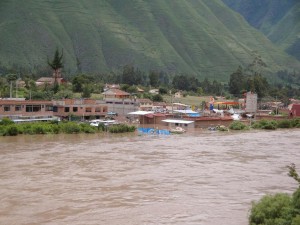
During the recent extreme flooding in Peru, media attention centred almost wholly and shamefully on the 1,300 tourists stranded at Machu Picchu. 

Now that they have been airlifted out from their luxury hotels – one told the television cameras that the helicopter ride ‘made his holiday’ – it is worth considering the real impact of the flooding on the people who actually live there.

For the episode is just a waymark in a far more important story.  The Andes is being ripped apart by a series of recent climatic disasters that threaten to destroy the fragile peace established since the terrible period of the Sendero Luminoso when Maoist revolutionaries held Peru to ransom in the 1990s.

The real story behind the flooding at Machu Picchu Read More »

The Masks of the Moche

Only a few weeks after hearing about the exciting excavations in Mexico, another archaeologist  has been in town to talk about equally exciting work that has been happening in Peru. 

Steve Bourget is a leading expert on the Moche, the ancient Peruvian civilisation who perhaps left the most splendid artefacts behind  – fabulous masks of turquoise and gilded copper, and ceramics of extraordinary variety, depicting pre-Columbian life in all its forms including, most famously, the erotic:  many of their pots are still kept in drawers marked for-the-over -18 only. 

He was describing his recent work at a site called Huaca el Pueblo, where they uncovered a tomb dating from around 300 to 500 AD.  Inside were the remains of four individuals, two men and two women, all in their twenties at the time of death.  Working at frantic speed over the space of five weeks to beat the threat from both the humidity and local looters, his team of archaeologists injected alcohol under the mask of ‘the highest status individual’ – who Bourget has called ‘the Lord of Ucupe’ – to loosen it up for removal from his face in the normal way.  They then used thin slivers of bamboo to lift it, only to discover another mask underneath, like a Russian doll. 

And what masks!  Made from large sheets of gilded copper and fashioned with elaborate Moche iconography:  octopus tentacles, owl-heads and, around one woman’s headdress, a ring of minute dancers. 

The Masks of the Moche Read More »

At least it will taste smoke-grilled…

In the aftermath of Copenhagen, it’s salutary to look back at past civilisations destroyed by bad ecological decisions.

There is the obvious example of Easter Island where all the trees were cut down for religious reasons, with disastrous effect:  the topsoil was subsequently eroded, fishing boats could not be made and famine followed.  There are the Maya, who likewise decimated the rainforests of the Yucatán over a millennium and are thought to have suffered drought as a result, which brought the classic period of their civilisation to an end.

But the example that is closest to home for me are the Nasca culture of Peru, about whom I’ve written in Cochineal Red. Famous for the lines they created on the desert plateau, the Nasca were wiped out by a series of ecological catastrophes in around 780 A.D. Recent research done by David Beresford Jones, an archaeologist from Cambridge, and his colleagues suggests this was because they did not value the huarango, the local extremely slow growing tree with unusually deep root systems that gives protection from harsh desert winds. By cutting them down, the Nasca exposed themselves to the elements with fatal results.

It’s not a lesson that modern Peruvians have gained much from: last time I was in Nasca, the huarango trees were still being cut down – not least because the local pizzerias valued the particular flavour they gave to the food when used under the grill. Sometimes one wonders if mankind’s criminally short term memory is matched only by the facile way we misuse our remaining resources.

But it’s a reminder that 21st century Western civilisation is not unique in the way that it has become so out of touch with nature – previous civilisations were often just as bad. Which is why they are no longer around.

At least it will taste smoke-grilled… Read More »

When the Aztec tomb of the Emperor is finally opened

I go to the British Museum to hear Leonardo López Luján talk about his work on the Aztec pyramids of the Plaza Mayor in Mexico City.  There is an almost palpable  air of expectation about the event — after several years of excavation, his team have reached the entrance to what may well be a royal tomb.  The glyphs on the doorway correspond to those for the reign of Ahuizotl, Moctezuma’s predecessor as Emperor of the Aztecs (or Mexica, as the British Museum keeps pedantically reminding us to call them).

Even the natural — and proper — caution of an archaeologist cannot prevent Leonardo from getting excited at the prospect.  And he’s had three years to do so — the monolithic lid to the tomb was first uncovered in October 2006 (by workmen clearing the wrong site by accident).  The reason it’s taken so long to excavate is that the water table is very high in what was once, after all, a  city built on a lake, like Venice. 

The tomb lid showed a representation of the nocturnal earth goddess Tlaltecuhtli carved into the pink andesite, with claws extended to receive the dead.  Ground-penetrating radar shows there are three chambers below the tomb lid.  Funerary offerings placed at the entrance to these chambers include gold offerings, the bones of an eagle and a dog, and the pelt of a spider monkey.

 The moment when the tomb is  finally opened may well be the first really momentous archaeological find of the 21st century: no tomb of an Aztec emperor has ever been found before.  And it will happen soon.

see Mexico City Dreams    The Traveller Magazine

When the Aztec tomb of the Emperor is finally opened Read More »

More Afghan thoughts

If there is one story that is currently under-reported, it is the proxy war that is being fought in Afghanistan : not the one between America and Al-Qaeda, but the one between India and Pakistan. While Pakistan feels that the Pushtuns are ‘their guys’ against the Indian-backed Tajiks, Uzbeks and other tribes, there will never be a chance of settling the conflict.

One Labour minister I met several years ago at Kabul airport after his tour of inspection was openly wondering how it was that while large packets of aid still went to India, it could still afford to send equally large packets of aid to ‘its men’ in Afghanistan. One can’t help thinking that some judicious diplomacy might restore a sense of perspective. Sending 30,000 more American troops – and 500 more British ones – is only part of the answer.

More Afghan thoughts Read More »

Afghan thoughts

[An expanded version of recent article for the Times]

Three years ago I was preparing to go to Afghanistan to make a Despatches Special for C4 with the intrepid Pakistani journalist Sharmeen Obaid-Chinoy about what conditions for ordinary Afghans were like. We wanted to make it in the winter of 2006-07 because there was talk of a Spring offensive from the Taleban – which indeed came – and came – and has kept coming ever since.

The difference in the country between then and now is striking. 

Afghan thoughts Read More »

Reflections on Festivals

We are coming to the end of another bumper season of literary festivals.  From Hay to Edinburgh to Saffron Walden, it sometimes seems that every town and city in the land is getting out the French regional white wine to welcome writers.

At Cheltenham recently, where I was giving a session on travel writing, they told me that overall this year they had sold more than 100, 000 tickets before the festival had even begun – a staggering amount, and far more than they have in the past.

When VS Naipaul gave a talk there a few years ago, just after winning the Nobel Prize, he suggested that the growing success of such events is not accidental;  it is because the appetite for such highbrow literary debate is no longer being fed by the BBC.   And the Beeb could do well to pay more attention to the phenomenon.  There is talk of cutting Newsnight Review on BBC2, the last remnant of The Late Show enterprise that once lit up the channel.  Given that it only runs once a week, and after 11.00 at that, this hardly seems a sacrifice that is necessary to make.  And nor is the egregious Culture Show any substitute  – a much more lightweight magazine format, without the same sort of sustained debate that could make Newsnight Review – or indeed a literary festival – such fun.

Reflections on Festivals Read More »

Edinburgh Festival and News for Summer 2009

…and a summer of Festivals continues.   Highlights of Edinburgh so far?  The opening of a new show by John Bellany at the Open Eye gallery;  the opening of a new gallery, the Glasshouse; and the scabrous and very funny stand-up show by Greg Behreindt, the script-writer of Sex in the City and He’s Just Not that into You.  Which is odd as not normally that ‘into’ Cosmo movies.  Best of all it’s been sunny. 

But the show that is a model of how to explore ‘the idea of a country’  is The Discovery of Spain at the National;   the curatorial work that’s gone into the exhibition and catalogue is impressive – and there’s a sense of how Spain went from the melancholy decaying empire of the 18th century to a place of duende and the unfettered imagination that the poets of the 1930s would go out to fight for.

Meanwhile I recently gave a reading at the Latitude Festival myself which was a lot of fun as could see Tricky do the ultimate crowd-surf (he was carried so far off from the stage-tent that he emerged in a field somewhere and the concert was over); Tequila Oil has been reviewed by the Independent, Guardian and Financial Times – and by Top Gear Magazine who said I was a good writer but clearly a lousy driver.

Also returned to Peru and the Inca site of Llactapata for a National Geographic and PBS Nova production:  we filmed there at dawn on June solstice as the sun shone down the narrow passageway designed to mark that day.  Then I had to do a piece to camera on what it all meant.

50 Wonders of the World has just been published  by Quercus for £25.  Which is a bargain, as it’s a handsome and very large book, which with a little carpentry could actually be used as a coffee table, not just on it.

Edinburgh Festival and News for Summer 2009 Read More »

Vann Fest

Following a reading at the wonderful and very large Latitude festival last weekend, now reading at the select and delightful invitation-only Vann fest (so-called not because it has anything to do with camper vans – as often assumed – but because held at place called Vann).  Which is where set up and began this blog, as plenty of helpful members of the travelling tech community to guide me into areas of cyberspace I have not previously wandered.

Vann Fest Read More »

Scroll to Top