Uncategorized

Aldeburgh Poetry Festival Friday

Friday late:   It’s an attractive opening bill: the narrative directness of JO Morgan’s story about a wild boy on Skye;   Matthew Caley’s louche rock ‘n’ roll take on Illinois, breast-feeding and Yeats (and claim that Ezra Pound used to lie at languorous angles on chaise longues so that his semen could seep down to his brain and improve his poetry);  and then, to round it off, Don Paterson.

Writing one-line descriptions of poets for a programme is a bit like a wine critic’s job.  Sooner or later you run out of adjectives.  Once we’ve had thoughtful, acute, rigorous, playful, incisive and that old stand-by prize-winning,  you have to start reaching for the unexpected.

Not quite redolent of hay on a mid-summer evening (though I can think of a few poets who would fit that bill) , but something ambitious.

Hats off then for the description of the wonderful Don Paterson who according to the programme shoulders the responsibility to live and write the fully-examined life with wit, courage and exemplary formal skill.  That’s some day-job!

These days, Don hardly needs a strap-line under the billing, such is the impression that recent collections like Rain have made. He even has an ‘official website’.

If this were a rock gig it would be the Proclaimers, followed by the Dandy Warhols, followed by Tom Waits.  Not a bad line up.

Indeed the night showcases all that is best about the Poetry Festival: poets reading well and with engagement to an audience excited to hear them.  The Jubilee Hall as a space always has a sense of occasion.  It’s big enough to make the performers onstage seem both vulnerable and intense; small enough for a sudden and surprising intimacy with them when the poems start.

It’s also a good moment to step back and appreciate what a formidable achievement the Poetry Festival is.  Without now receiving a penny of Suffolk County Council money, it manages to keep an impressive wave of energy beating each year against Aldeburgh’s shingle shore.

But as Naomi Jaffa, the festival director, announces (“I’m going to do something very un-English:  I’m going to talk about money”), with the current cuts on the horizon, it will need all its  many supporters to rally round if it is to keep going.

All three poets read tremendously well.  Don Paterson has learnt his by heart, and his reading brings out both the underlying emotion and rhyme in equal, carefully weighted measure.  While apologising for the fact that he feels so much of his last collection dealt with ‘death and divorce’, he also reflects ruefully on the ageing process:  ‘ one no longer appears in one’s own poems – one’s presence is more of a heraldic affair.’  And he now takes siestas, although as a longterm hispanophile, we would have expected nothing less of him anyway…..

He reads several more recent, unpublished poems, including some from a sonnet sequence that he is beginning (he is at number eight or nine out of a planned 48),  He also reads ‘The Day’,  inspired by the DVD box set of Battlestar Galactica, no less, with a conversation between two aliens who have just got married:  it’s engaging, direct and funny, although the insistent little six-year-old boy inside me taps me on my shoulder at one point and asks, ‘ did that man just say the earth was a star?’

.

Friday 19.00  John Glenday gives a modest and intriguing Craft Talk, on the art of revising, for which he is well qualified,  running often to 30, 40, 50 drafts of his own poems.  It has taken him 15 years to fine-hone his most recent book, ‘filling the white grave of the page with words’.  Over the years he has come to recognise which early drafts will never respond to treatment, remaining ‘ghost poems’ and those which it is worth pursuing down the corridor.

It’s a fine-honed talk as well, with not a word wasted and some fine aphorisms (some quoted from other poets):  inspiration is an inclination to take notice;  poetry is a river that widens into silence; the poem as a balance between craftsmanship and intuition.

One question though.  Why is it always easier to sound modest if you have a Scottish or Celtic accent?  Something to do with the dying fall at the end of each inflected sentence, of which the great and under-rated Glaswegian comedian Arnold Brown is a master.

.

Friday 17.00   I enjoy giving a class on the crossover between poetry and travel writing, using Elizabeth Bishop’s ‘Questions Of Travel’ as a central text, from her book of the same name.  Writers in both prose and poetry when they travel can constantly criss-cross the borderline between detachment and engagement, observing the strange phenomena of a new country and taking part in them if they so choose.  It’s a process we all do in our daily lives anyway, but somehow heightened in a foreign country, and fertile territory, with its own tensions and ambivalence:

Should we have stayed at home and thought of here?
Where should we be today?
Is it right to be watching strangers in a play
in this strangest of theatres?

 (Elizabeth Bishop ‘Questions Of Travel’)

.
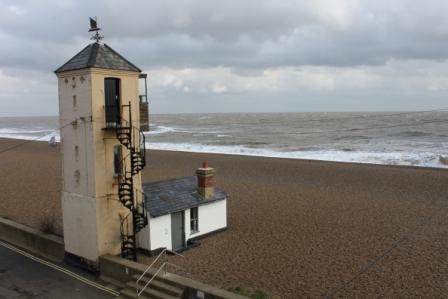
Friday 11.30   my own turn to get locked away comes around.  The festival has the use of an old lookout tower on the beach, and poets are encouraged to go up there for some silent meditation or even (and the organisers phrase this delicately) “possible writing”.

Writers can be both fussy and stringent about the conditions for perfect writing – not least because it is the perfect displacement activity for actually doing any.  Finding it hard to face that blank sheet of paper?  It’s all the fault of background noise, or stains on the wallpaper, or those bills elsewhere on the desk that need attending to.  No wonder writers need their sheds.
I’d noticed this just earlier in the morning when I realised that my small back bedroom in the eaves of the Poets House was, while perfectly clean and adequate, impossible to write in — all bed and no table.  In short, the perfect excuse.

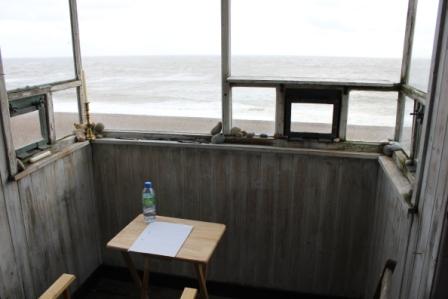
But the lookout tower offers no such escape.  There are nine biros beside a block of paper.  The view is magnificent.  The waves break with a soft insistency.  The bleached wood is restrained and tactful.  Even the temperature is ambient.

I’m reminded of the problems I experienced at a Buddhist retreat last winter:

.

      Bad Pupil 


When I went to the Buddhist Centre retreat I found myself being continually distracted

by the soft, smoky runs of the boiler igniting  its regular puffs of disbelief

and by the distant catcalls of children

playing in the garden, while we sat inside,

in postures of graduated discomfort and in complete silence.

 .

The practice of mindfulness is not one that comes easily to me. 

 .

There is a ticking clock in my head, counting down the days, the hours, the minutes

 .

and never quite reaching the present tense.

 .

But then the Zen Master explains that it is like being at a drinks party

and only talking to the one person, yourself, rather than being distracted

by others.  ‘Make eye contact with yourself,’ he suggests.  Or ‘I contact’,

as I understand him to say in a moment of rare connection

that blows away when someone else speaks.

.

Friday 08.30    Can’t quite believe I’m blogging before breakfast but clearly a stream of consciousness blog will demand a dedicated approach.  Let alone all that stuff about Trollope knocking off a few thousand words before even having a cup of tea, and then doing a full 9 to 5 as a postie.

Now ensconced in the Poets House on the seafront where poets were gathering last night for a bit of pre-match banter and limbering up (over several bottles of excellent Chilean red) – The first person I see when I walk off the street is  J O Morgan at the kitchen table talking enthusiastically about Ted Hughes.  But then the man’s been locked up in solitary confinement for a week in Thorpeness as part of his winnings for last year’s Aldeburgh First Collection Prize (‘a week of writing space’), which would make anyone want to hold forth a bit.  Wonder what they do to you if you lose?   (Joe is reading this evening with Matthew Caley and Don Paterson.)

Topics on the agenda over dinner are:  whatever happened to (‘For Lizzie and’) Harriet Lowell after all those poems about her;  was Lowell patrician and snobbish about his Irish servants;  what mobile signal works here?  And a brief foray on Iraq, but as everyone was in complete agreement, we moved on……. 

.
(c) Peter Everard Smith


Thursday 15.00     Just off to the Aldeburgh Poetry Festival  – sadly not in the Oldsmobile on the right, as suggested in the festival e-letter, but a more sedate beemer – so watch this space as the Festival begins on Friday for posts, musings and comments over what promises to be a long and intriguing weekend: as well as giving a talk and class on the  relationship between travel writing and poetry, I’m to be their official blogger….

.

The Aldeburgh Poetry Festival blog is sponsored by Writers’ Centre Norwich, a literature development agency for the East of England running workshops, competitions, events and more. www.writerscentrenorwich.org.uk

Aldeburgh Poetry Festival Friday Read More »

Apple Day

It’s a perfect recipe for a communal village activity:  bring your ripe and surplus apples to the green, have them pulped and pressed to juice, play various arcane games with apples (‘apple bowls’ – quite a few inswingers – , an ‘apple-shy’ with prizes if you can knock them off their perch), eat local pork with apple sauce.  And of course drink copious quantities of  the actual juice, which constantly changes flavour during the day as different types of apple are added to the mix. 

In this small Oxfordshire village by the Chilterns, almost every garden has an apple tree and few can be bothered to store the fruit over winter in newspaper and sheds, let alone juice them, so much would just rot on the bough.   The big communal apple press on the green is satisfying in its simplicity, with layers of pulp in crates, separated by sheets of coarse muslin and with a long lever that everyone from kids to adults can take turns in wheeling around to extract the frothing liquid.

Roger Deakin would have loved it.  The Common Ground group he helped found were some of the first to celebrate the variety of the English apple, so that we did not succumb to a Golden Delicious monoculture (what Roger called ‘Tesco’s Delight’).  He died four years ago, just after completing his wonderful Wildwood: A Journey Through Trees, and is much missed by his friends.  I wrote this in his memory:

.

Roger Deakin
(1943 – 2006)


The dark red windfalls from our apple tree

reproach me silently;  I never knew

their name or provenance until you died

so suddenly;  or cared about the orchard

with its Russets, Bramleys, old Charles Ross,

the quince tree pregnant with unwanted fruit,

a mulberry staining the cut-grass red; 

 .

and now you’re dead;  and there’s no chance

to walk your coppiced woods again, or hear

that rich, smoked voice describing how

the railway shed has fresh clean linen

always waiting for you on its bed

in a bower of alder and ash.

Roger, I eat this apple for you:

 .

The Devonshire Quarrendon Red.

Apple Day Read More »

Lieder without Lager

As a lover of small but perfectly formed festivals, I’m drawn to the current Oxford Lieder Festival and some concerts at the Holywell Music Room.  There is a numinous performance of Schumann songs by the young and very talented Stuart Jackson who is built like a prop forward and sings with the delicacy and adroitness of a winger;  he also endearingly has his shirt hanging out from his suit at the back. The songs of love, loss and Lorelei are terrific, with Jackson’s tenor accompanied by the equally talented and young Welsh pianist Jocelyn Freeman.

 But there’s one problem.  Songs such as these should be enjoyed, as at a true Oktoberfest, in the autumn sun with a large cold stein of lager to hand.  Not in a hushed auditorium.  It’s like listening to salsa and not being allowed to dance……

Lieder without Lager Read More »

The British Museum and a ‘forgotten continent’

The British Museum richly deserves the recent donation of 25 million from Lord Sainsbury.  Over the last few years it has been playing at the top of its game, with some breath-taking exhibitions and intelligent curatorship.  In Neil MacGregor it has a capable and charismatic Director, whose series A History of the World in 100 Objects, now just drawing to a close, has been one of the broadcasting successes of the decade.

But – and it is a very big but – there is one stain on an otherwise exemplary stewardship.  Look around the Museum and the visitor will quickly notice that an entire continent has been side-lined, excluded from what claims to be a ‘world museum’.  All the ancient civilisations have a gallery devoted to their achievements except one:  South America.

It is as if the achievements of the Incas and their extraordinary pre-Columbian forbears had never happened:  the wonders of Machu Picchu;  the gold tombs and masks of the Moche, often compared to Tutankhamen;  the Nasca culture who produced the famous lines;  or the many other intriguing pre-Columbian cultures of the Amazon and of Peru.

There are a few objects scattered around amidst other wider collections – but no permanent and focussed gallery;  nor has there been any exhibition about the Incas or South America for many decades; nor is the Museum planning to hold one, though it is perfectly possible– as Paris and New York do frequently – or to get long-term loans for a gallery. It is just that there is no particular will to do so. The Museum actually has plenty of holdings on South America shut up in the basement, left over from the old and now closed Museum of Mankind.

The centenary of the discovery of Machu Picchu falls next year, for instance, an event that the rest of the world is already celebrating – Paris has an exhibition right now – and which we are doing absolutely nothing about. 

The last time that the Museum was given money and Andeanists expected a long-standing wrong finally to be put right, the new gallery unveiled was… a Watch Gallery. Perhaps this time around the money should be used to represent a forgotten continent.

The British Museum and a ‘forgotten continent’ Read More »

Walking with ghosts


Reading Bruce Chatwin’s wonderful letters recentlysee my review for the Independent – I came across a detail that brought me up short:  that Chatwin, while a mature student  at Edinburgh, used to go to Glen, the country house of the Tennant family near Innerleithen. He writes to the deeply eccentric recluse Stephen Tennant about it. 

So what?  Well I went there myself a great deal as a teenager, as the son of the household, Henry Tennant, was my closest friend.  It was a special place for me, about the only place I knew in Scotland, with its crazy Victorian Gothic castle and romantic glen leading up to a loch and trout stream where we used, ineffectually, to fish.

.

So the discovery that Chatwin used to go there as well had a special resonance.  Not least because the place has been in my thoughts as its then owner, Colin Tennant (Lord Glenconner), another eccentric member of the family, has just died – see Phillip Hoare’s obituary.  As a teenage boy, I found him a frightening but fascinating mixture of playboy charm and occasional irrascability;  he was a nightmare to partner at tennis.

It was not a happy time for Chatwin – he found academic archaeology stultifying, as I often do – and he left a cold Edinburgh flat prematurely, with little money left.  Glen was clearly a place of refuge for him; as it was for me.

Why do we like to think of our heroes as having trodden the same ground as we have?  Do they leave some footfall that we can pick up?  Walking with ghosts is something I increasingly find I do on my travels.

I sometimes go back to Glen as I know the current chatelaine, Tessa Tennant;  and the next time I do, I will be thinking of Chatwin as I walk up to the loch and the glen.

Walking with ghosts Read More »

Down the Amazon, no direction home

The recent news that ex British Army captain Ed Stafford has completed his 859 day walk along the Amazon from its source to the sea deserves comment – and praise. It’s an epic achievement and one never achieved before.  Previous attempts  have always been made partly by boat, and for good reason:  some areas of the Amazon, like the Solimoes in Brazil,  flood for hundreds of kilometers each year and there are no roads along the main river, so to walk the entire length is daunting.

I also like his candour.  He told the wire-press agency AP that he was “no eco-warrior” and that while, like all of us, he deplored the destruction of the Amazon rain forest, his own expedition was at its heart simply a grand expedition of endurance:  “The crux of it is, if this wasn’t a selfish, boy’s-own adventure, I don’t think it would have worked.  I am simply doing it because no-one has done it before.”

In these days when every expedition has to have its ‘eco-message’ , however admirable (like the Plastiki, which has just sailed the Pacific on a raft made from recycled plastic bottles that unfortunately proved very difficult to stop drifting sideways), I find this quite refreshing.  The elemental urge ‘to be the first to do something’ has always been an immensely productive one. …

Down the Amazon, no direction home Read More »

Stonehenge – a national disgrace

Stonehenge was given to the nation in 1918.  So far, almost a century later, the nation has done a remarkably bad job at looking after it. 

The situation at the site is currently, as its custodians English Heritage put it, ‘severely compromised’ and as others like leading archaeologist Mike Pitts would say, ‘ an embarrassing, abominable, inexcusable mess’. For decades, plans have been put forward to improve the site and then postponed.

Two main roads not only thunder past but divide the circle of stones from the Avenue that should lead to it.  The findings from Stonehenge are scattered piecemeal between some sixteen different museums and private holdings around the country.  For the almost one million annual visitors drawn there, it can be a dispiriting experience, with the stones themselves fenced off and the current ‘visitor centre’ resembling a British Rail station built in the 1970s.  Overall, it can be a bit like having a picnic in a car park.

Just last week the Government announced that it would no longer help finance the proposed new landscaping and visitor centre which Labour had announced last October. 

On the face of it, this might seem perfectly reasonable.  A saving of £10 million would result.  We all know that cuts have to be made;  the Government claims that Labour committed to projects that were never affordable. …

Stonehenge – a national disgrace Read More »

Lidar ranging

There’s nothing as seductive as new technology, particularly in the world of archaeology.   Some years ago I co-led an expedition that expended an inordinate amount of energy using a thermal imaging camera.  We flew over the cloud forest near Machu Picchu to determine the full extent of the nearby site of Llactapata, at a cost of $1000 per hour for the plane, let alone for the camera.  Its infra-red vision was supposed to be able to detect the difference in temperature between stone buildings which retain heat, and vegetation which does not.  By using it, we hoped to  be able to see through the cloud-forest to any ruins below the canopy  – the archaeological equivalent of those X-Ray specs sold in schoolboys’ comics to look through women’s skirts, and in the event about as successful.

We ended up going into the forest on foot and looking in the more traditional manner, with machetes, frustration and a great deal of sweat.  (The full story is told in Cochineal Red for those interested.)

But an even newer technology has come along that sounds rather more effective:  lidar (‘light detection and ranging’).  Gamers have used it to create virtual reality sites for some time.   Now the husband-and-wife team of Arlen and Diane Chase have adapted  it at Caracol in Belize to penetrate the jungle cover and create 3-D images of one of the great cities of the Maya lowlands.

In the process they’ve established that the site was far more extensive than had ever been expected:  the city sprawled over some 70 square miles.

Diane Chase was quoted as being  ‘blown away’ by the new technology:   ‘We believe that lidar will help transform Maya archaeology much in the same way that radiocarbon dating did in the 1950s and interpretations of Maya hieroglyphs did in the 1980s and ’90s.’

Apparently, however,  they also emphasized that ‘it would not obviate the need to follow up with traditional mapping to establish “ground truth.” ’  What a terrific phrase – ‘ground truth’.  Now that’s something I’ve been searching for my whole life…..

Lidar ranging Read More »

Mine’s a michelada

Once Acapulco was a remote and glamorous resort on Mexico’s Pacific coast.  Mass tourism from abroad and from within the country has changed all that.

Now it should be enjoyed more for the vitality and vulgarity of a latin Blackpool or Coney Island: plates of fried bananas and whelks;  rubber rings and trinkets in brash colours;  kids dashing under the waves or burying themselves under the brownish sand (no one can claim Acapulco has the purest water in the Pacific – a million people live there).  Along the central drag is a large, kitsch statue of a plump Diana firing her arrow directly at a gigantic inflated bottle of Corona.   Overhead, frigate birds try to mob the boobies and the gulls to get them to disgorge their fish.

I like best the old working fishermen’s beach at the north end of the shore, near the fort once used to keep the area free from English pirates like El Drago (Drake).  There the pelicans cluster round the catches, hopping from foot to foot like embarrassed teenagers at a ball waiting to be asked to dance.  These are not the picturesque Disney white pelicans of further north and California, but the brown ones of the Latin American seaport, with their ponderous heavy-jowled flight. 

The drink of choice for the locals is not tequila – that’s for the norteños or the American college kids who come here for their ‘Spring Break’ to party hard in the surf.  No the drink here is the michelada, a light beer with salt and lime on the rim of the glass, and a dusting of chilli powder to give more power to your elbow.  The more of it you  drink, the more of it you need to drink. 

I have one on the old fishing pier, watching the pelicans clustering together on a buoy and looking down the strip towards the gleaming high-rise hotels at the south end of the shore, now half empty with all the talk of Mexican drug crime (20 were killed in a nearby Acapulco suburb recently).  And then I have another.

Postscript:  and for those doubting that Acapulco has been infected by Mexican drug crime, see this more recent report

Mine’s a michelada Read More »

The White Stuff: How bird-shit can change your life

I’m coming into port at Pisco, past the Paracas Peninsula. It’s  home to a culture who created some of the finest of all pre-Columbian weavings, but I’m more interested in the bird-shit: in the guano islands that are dotted over the sea as one approaches, with frigate-birds and pelicans flying between them, over a fishing ground that even now, after the depredations of Chinese fishing tankers, is still one of the richest in the world.

It was the Incas who introduced the world to the idea of guano as a fertiliser – ‘guano’ is a Quechua word.  By the 19th century it had become a huge industry, with fortunes being made;  the Gibbs family of Tyntesfield being the most famous British example.  As with any commodity in the New World, the rights of natives were trampled in the rush to lay hands on the money.  At one point, the entire population of Easter Island was transplanted by force to work the guano fields.

Over time, the use of guano came to be replaced by the nitrates mined in neighbouring Chile – a new trade the British supported, backing Chile in the ” War of the Pacific” against Peru and Bolivia to secure their interest in the nitrate holdings.

But it is now enjoying a revival, as an organically approved fertiliser.  Every six or seven years, depending on the frequency of el Niño, the locals “harvest” their crop on three islands off the Paracas Coast, La Chincha, Ballestas and Isla Blanca, and get some 40,000 tonnes of the white stuff.  It sells at two dollars a kilo, a good commodity price, although the work needed to extract it is backbreaking and often dangerous, with ‘guano-slides’ when stacks collapse;  they bring tough miners down from the mountains to help.

It’s the guano that helps make the Pisco valley so green:  as I leave the boat and drive into the desert, an oasis appears of cotton and maize fields, with orange groves and palms dotted throughout — a vision of what organic farming can achieve.  There’s a satisfaction in feeling that something so intrinsically useless as bird-shit should yet be so useful.

The White Stuff: How bird-shit can change your life Read More »

Scroll to Top