Archive

Archive for the ‘worldwide travel and exploration’ Category

Paul Fussell: An Anniversary Tribute

May 23rd, 2013 No comments
Pfussell1945.jpg

Lt. Paul Fussell in Paris, France, May 1945

I was in Philadelphia recently and thought of Paul Fussell, who lived there before his death this time last year and whom I knew:  one of the finest writers about 20th-century war, both because he wrote about the subject as a cultural critic more than military historian and because having fought in WW2 both in Europe and the Pacific, he knew what he was talking about.  The Great War And Modern Memory is his most famous book – but I have only just read one of his very last books, The Boys’ Crusade.  Subtitled ‘American GIs In Europe: Chaos And Fear In World War II’, it highlights some familiar Fussell themes:  how many American soldiers were teenagers, how little about war they knew before they went, and how many cock-ups there were.

Like all of his books – and like his conversation – it is candid and clear-sighted, just like the Augustan prose he so admired (he was a professor of 18th-century English Literature).   Unlike most books on WW2, it is also elegantly short.

But if his other achievements were not enough, he also helped in the revival of interest in travel writing, for which I am more directly grateful to him.  His book, Abroad: British Literary Travelling between the Wars, championed travel writers of the 1930s like Robert Byron who had largely been forgotten at the time.

I was once with him when a BBC executive (I was trying to get the BBC to make a programme about and with Paul) asked him if he had ever met any Germans.  Fussell gave him a stare:  ‘Any Germans I met during the war, I killed.’  The executive blanched.

Read more…

Panspermia

March 11th, 2013 No comments

I’ve always been fascinated by the idea of panspermia: the theory that Fred Hoyle and others put forward almost 30 years ago that – very broadly put – life was distributed across the universe by meteorites.

It’s often been ridiculed by other astronomers and physicists – let alone biologists – for being simplistic, but that surely is part of the charm: we should look for an elegant simplicity in our scientific solutions.

So the news that scientists, including a former colleague of Fred Hoyle’s, have identified biological matter in the heart of a meteorite that recently landed in Sri Lanka, in December, should have attracted much greater attention than it has.

This judicious and weighted article in the August M.I.T Technology Review puts the case.

My more frivolous case for panspermia is below:are 

The first Big Bang:

panspermia flood

through space, lactating

fireworks against the black;

meteorites cross-pollinate

 .

between planets,

extremophile bacteria

clinging to the rocks

like a rodeo:

‘yi-haaaaaah!’

 .

The Earth got lucky –

we were fertilised.

But what I want

to ask the Universe

is this:

 .

‘How was it for you?’

An outrageous plan to build a new airport for Cusco on the beautiful highlands above Chincheros

February 4th, 2013 2 comments

Interesting piece in this week’s Economist which confirms what I was suggesting in a From Our Own Correspondent report for the BBC last year, that Peru is booming away at a phenomenal rate of between 7% and 9% this year, figures that those of us experiencing double or treble dip recessions can only dream of.

The boom has been helped by strong minerals, cautious banks (you have to be a cautious bank if you’re operating in Latin America!) and an emerging middle class.  It’s seen the dollar fall against the local currency, the Peruvian sol, by some 25% over five years – not such good news if you’re planning to travel there, although compensated for by rapidly improving infrastructure:  over the last decade, the number of roads in Peru has doubled, an extraordinary statistic for this huge country that is five times the size of the UK.

But with wealth comes responsibility – and in particular, responsibility for the environment, not something that has always been Peru’s strong suit (remember the riots about introducing gas pipelines to the Amazon, when local indigenous tribes confronted the army and police).

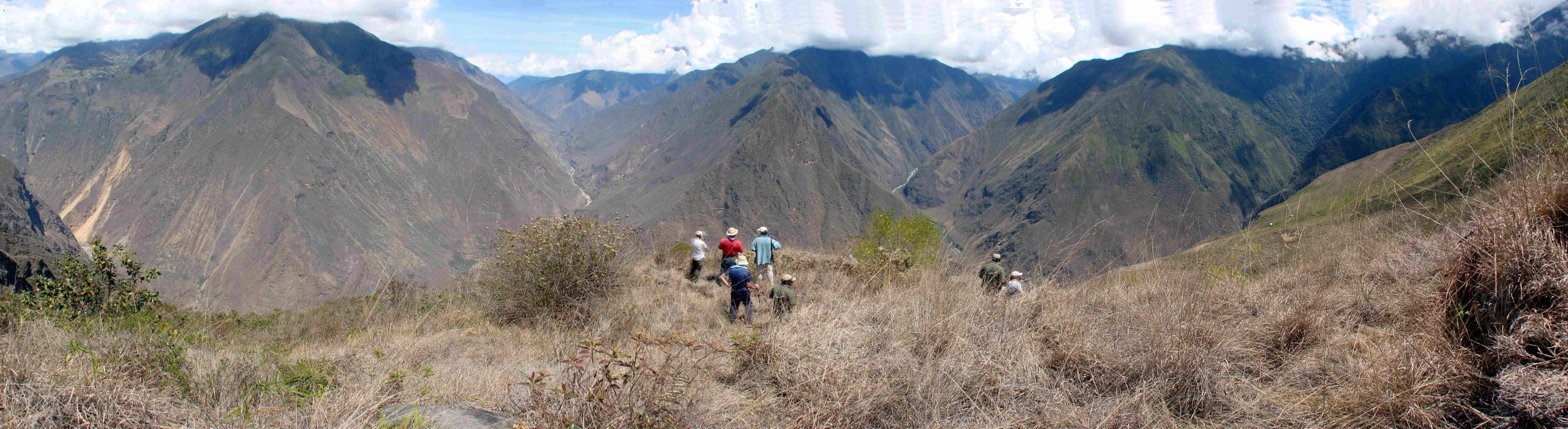
Now there is an outrageous plan to build a new airport on the beautiful highlands above Chincheros, some thousand feet above Cusco, which is the city that it would serve.

The old airport in Cusco is deemed to have run its purpose – mainly because it can’t take international flights, and also because developers are eyeing up what has become a valuable inner-city resource for housing, having started off as a few fields on the outskirts of town when I first went there in the early 1980s.

There are some doubt as to whether a new airport would really do much better for international flights – and no doubt at all that it would be a huge eyesore on one of the most beautiful areas close to Cusco and one which many tourists see as they travel over towards Machu Picchu.

My old mate Nick Asheshov has written astutely about this in his column for the Peruvian magazine Caretas.

The idea has been ticking over for years and no one really thought the authorities would quite bring themselves to do it. Tragically, it now sounds as it is a done deal, as large amounts of money have been handed out to the local communities already as recompense.

The view over the Chincheros plain to Mount Verónica, past lakes and fields of growing quinoa, is one I have always cherished and I for one will be very sad if it now becomes a sprawl of not only the airport but all the ancillary hotels and mess that an airport inevitably brings.

Machu Picchu in the clouds

September 21st, 2012 No comments

There is a good interesting roundup of current theories about Machu Picchu in the Peruvian Times in which the author, Rick Vecchio, sensibly doesn’t commit himself too far in any particular direction…

…Unlike many of the guides at Machu Picchu who are still perfectly capable of telling you that this was where the Inca emperor hid his Virgins Of The Sun and that stone over there was where they sacrificed the black llamas.

.

For my own brief introduction to the interpretation of the ruins, take a look at the short film I did for CNN last year:  See Hugh’s cut-out-and-keep 5 minute guide to Machu Picchu for CNN.

.
Then you’ll understand why I prefer to use this picture of my own in which Machu Picchu is covered by cloud, rather than the usual sunlit panorama.  It’s a place we still don’t fully understand although we have recently gained some useful pointers.

2012 – End of the Maya Long Count

August 20th, 2012 No comments

Catastrophe theorists have been having a field day – or rather year.  2012 is when the Maya long count ends.

As catastrophe theorists have loved to point out, 2012 marks the end of the old Maya long count, the end-date of a 5,125-year-long cycle;  but before we get too depressed,  Mayanists have been quick to add that just because one count ends, it doesn’t mean the Maya believed another couldn’t begin.

As ever, nothing is ever quite as you think it is with the Maya.

Thirty-five years ago, I visited my first Maya site, at Palenque.  From the top of the Palacio temple, a staircase led down inside it to the burial chamber of a ruler.  The ‘secret staircase’ – it is difficult to use any other less melodramatic term – had only been discovered in 1949.  An archaeologist noticed there were holes which had been filled with stone plugs in one of the floor slabs;  the temple wall also extended below ground level, suggesting some lower chamber.

When they lifted the slab, they found a stairway filled so densely with rubble that it took three years to get to the bottom.

Going down the corbelled staircase on my own felt like something out of John Buchan.  At that time, visitors were asked to bring their own torches, as there were only low-voltage lights running from an intermittent generator.

For the archaeologists who first saw the funeral vault at the bottom, it must have been the revelation of a lifetime:  the room was still preserved as they had found it, with the king’s funeral tomb dominating the chamber.

The size of the crypt was impressive:  it was at least twenty feet high.  After the descent down a narrow staircase, this was like finding a cavern after pot-holing.

In the years since my visit, much has changed in our understanding of the Maya – from new archaeological discoveries, but above all because we can now finally read the glyphs on the temple stelae.  Read more…

Shakespeare in Kabul

April 26th, 2012 No comments

Shakespeare in KabulA remarkable new book has just come out about trying to mount a production of Shakespeare in Afghanistan, using a mixed cast, which of course is in itself a radical step.

Even the discussion about which play to select caused endless difficulties. Most of the comedies have “Male-female interactions  that could be problematic in performance”:  the Merchant of Venice raises issues of anti-Semitism; Measure for Measure and the Taming of the Shrew are not funny in a country where many women continue to be treated badly;  Miranda pursues a young man in The Tempest in a way Afghans would find ‘inappropriate’.  Obviously the history plays with their themes of invasion and insurrection could have played well – Richard II being a strong candidate.

But the producers did want to try to introduce a large female cast, so the search was on for the right comedy.

Eventually they settled on Love’s Labours Lost with its courtly conceit of four young men retiring from the world, and four young women disturbing that seclusion.  But even that caused problems. At one point the young men are required to disguise themselves as Russians to woo the women.  The actors categorically refused to dress up as Russians.  Eventually a compromise was reached.  They would disguise themselves as Indians instead.  As I know from my own travels in Afghanistan, because of Bollywood movies the Afghans think of India as the home of romance, so this transposition made sense.

As did these wonderful – and in Kabul, revolutionary – lines from Biron’s speech on the folly of forswearing the company of women:

From women’s eyes this doctrine I derive:

they sparkle still the right Promethean fire;

they are the books, the arts, the academes,

that show, contain and nourish all the world.


Shakespeare in Kabul (Haus) is by Stephen Landrigan and Qais Akbar Omar 

Penguins and Battlefields

January 11th, 2012 No comments

 .

No one would ever go to the Falklands for either the weather or the view.  That at least has been the traditional opinion ever since Darwin commented on his first arrival, ‘scarcely any views can be more dismal than that from the heights: moorland and black bog extend as far as the eye can discern, intersected by innumerable streams, and pools of yellowish water….. These islands have a miserable appearance.’

Like the Hebrides though, catch them on a good day with a bit of sun and they have their own wild beauty.  Throw in some accessible colonies of penguins and you have the beginnings of a tourist trade;  a surprising amount of passenger boats now stop there for a combined ‘Penguin and Battlefield’ tour, with fish and chips in one of the pubs in Port Stanley afterwards.

One reason for the bitterness the islanders feel towards Argentina is apparent as soon as you drive out of Stanley – the amount of land that is still uninhabitable because of landmines, including many of the beaches which they used to play on as children. The cost, both human and economic, of trying to clear such large areas has proved too much.

Read more…

Back in Buenos Aires

December 24th, 2011 No comments

I’m back in Buenos Aires after 20 years. Outwardly, little has changed in the centre of the city. At San Telmo market they still sell Carlos Gardel, Maradonna and Benny Hill dvds, with a curious mix of old gaucho belts, movie cameras and Art Deco soda fountains. The steaks are as big as planks; the women as tall and elegant as greyhounds. The economy somehow manages to make life expensive both for inhabitants and visitors, and Peronist politics, as re-imagined by the Kirchner dynasty, are as incomprehensible as ever.

But there’s a big difference down at the docks. The old desolate area of Madero has been transformed by new buildings and promenades beside the waterfront, along which the gilded youth of B.A. rollerskate and hang out in the sun wearing as little as possible.

Porteños have always been a neurotic bunch.  It’s said that there are more psychotherapists here than in any other city on the continent. I put it down to the fact that, like some New Yorkers, they’ve always secretly wanted to be Californian but never had the access; now they can. I pass a pair of bronzed young men stripped to the waist and sipping maté. There is an equally bronzed statue of Fangio and his famous racing car; and memorial plaques to the disappeared of the dictadura.  Now that even the blonde angel of death, Alfredo Astiz, has been put away behind bars, there is a sense that that terrible period of their history is behind them, although the ghosts of 30,000 people still stalk the streets.

What gives me the greatest pleasure are the avenues of Linden trees they have planted, a tree which flourishes in Buenos Aires, just as in Berlin, but has almost died out in its wild habitat in England, despite once covering most of the south of the country in prehistoric times.  It is a fabulous tree, a tree with translucent green leaves and fragrant white blossom. As a symbol of a renascent city and country, it’s hard to beat.

Espíritu Pampa: The Last City of the Incas

October 27th, 2011 3 comments

.

.

Ten years ago I sat in the middle of the ruins of Espíritu Pampa and despaired that it would ever be cleared. Dense jungle covered the site. Kapok trees had ripped open the Inca stonework, their roots gripping doorways and niches. Brush obscured the lines of the great Plaza, the kallankas and the ornamental fountains.

.


The work of ever restoring the place seemed both Herculean and pointless – the ruins were too extensive and remote, the vegetation just too dense, for this, unlike most Inca sites, had been built not in the mountains, but in the jungle on the eastern slopes of the Andes as they joined the Amazon.

The site has enormous emotional resonance – ‘the last bastion of Inca resistance’, as a noticeboard proclaims at its entrance, it saw the final dying of the flame after the Spanish conquest in 1532. Having held out in the mountains of the Vilcabamba for some 40 years, by 1572 the last Emperor, the young Tupac Amaru, was on the run, pursued down here into the rainforest by a Viceroy intent on finally wiping out “the pretender across the mountains”.

Espíritu Pampa was burnt in the process; the Emperor caught and executed.

But perhaps because it is such a potent symbol, the Peruvian government have made a superhuman effort and cleared it – one substantial section just three weeks before we arrived. I can finally appreciate the immense size of the site, radiating out from the central Plaza where they have tactfully left a few of the giant kapok trees.

Now is the time to visit, before the vegetation returns under a less benign or interested administration; or when someone realises that with just 30 or so visitors a year making the week long journey, the cost of maintaining it cannot be justified.

Highway to the Sangre de Cristo mountains

August 30th, 2011 No comments

road to Sangre to Cristo mountains, Colorado

.


In Colorado to ride horses in the mountains.  One of the first times I’ve been in rural America – most of my previous visits have been to the cities – and I’m blown away by the scale and wilderness.  The largely empty highways seem to go on forever.  The mountains are chunkier than I’d expected as well – we’re a stone’s throw from Pikes Peak at over 14,000 feet.


Even the apples are bigger in America. And there’s a reason for that.  They grow a thousand times as many apples in the States as in Britain, but they prefer theirs to be ‘meal-sized portions’ – so they export the little ones to us, with our smaller appetites and orchards.

We take a pack trip into the Sangre de Cristo mountains, south-west of Colorado Springs, and spend some nights at over 10,000 feet with nine wonderful horses who pick their way surefootedly across some difficult terrain.  The forests are a rich mixture of aspen, spruce and pine, with wild raspberries growing underfoot and a few bears lurking around to add spice to the mix (we have a large Great Dane with us called Guinness, who is said to be more than a match for any bear, as they are notoriously afraid of dogs).

I’m with my old friends Gary Ziegler, who has led trips with me in Peru many times, and his wife Amy Finger.  Their Bear Basin Ranch lies on the old stagecoach route to Westcliffe, and has over 4000 acres of fine riding country to explore.

By coincidence I’m just re-reading John Steinbeck’s excellent Travels with Charley, in which he also travels across America with a large dog, who at one point barks at a bear.  It’s almost exactly 50 years old, written in 1961, published 1962, almost his last book and a fine tribute to his love for the wide open spaces of America as well as a melancholy forecast of some of the changes he could see coming.  It came out the year he won the Nobel Prize and was subtitled ‘In Search Of America’;  perhaps helped by the Nobel Prize, it was a bestseller and deserved to be for the simple, direct approach he took to travel writing, and his perfect ear for American dialogue:  ’the Badlands of Missouri are like the work of an evil child…’